 Visit Tokyo Guide
Hakone Day Trip from Tokyo
A Hakone day trip from Tokyo is an hour and twenty minutes on one train and then a circle: a mountain railway that reverses up the hillside, a cable car, a ropeway over a live volcanic vent, a boat across Lake Ashi and a bus back down to where you started. This page prices the circle from the operators' own pages, works out when the Hakone Freepass beats single tickets, and says plainly which two failures ruin the day. The wider list of destinations sits on the day trips hub, the city itself on what to see in Tokyo itself, and the fare logic that applies before you leave the city is on getting around Tokyo.
Quick answer What the loop is, what it costs, how long it takes, what closes it
Hakone is a loop rather than a single sight. Odakyu's Romancecar runs Shinjuku to Hakone-Yumoto in about 80 minutes, and from there a mountain railway, a cable car, a ropeway, a lake boat and a bus hand you round the crater and back. The Hakone Freepass covers all of them at ¥7,100 for two days from Shinjuku, about $46.00, and no one-day version exists.
Key takeaways
- The pass is the same product whichever way you buy it: Odakyu's counter price is ¥7,100 and the two-day Hakone train pass card is listed at $46.10, so the only question is whether you want it on your phone before you land.
- The Romancecar is a supplement, not a fare. It adds ¥1,200 one way, fifty yen less as an e-ticket, on top of the ticket or the pass; the ordinary express covers the same ground in about two hours with no seat reserved, which is the same trade the Tokyo fare system asks everywhere.
- Two things break the day: Owakudani closes for volcanic gas and the ropeway stops for wind, in which case the operator runs a replacement bus over the affected section rather than shutting the line. Plan the circle so the crater stop is not the reason you came, and keep Mount Fuji viewing plans on their own day.
Key facts
Opening hours
| Hakone Ropeway boarding, February to November | 09:00–17:00 |
|---|---|
| Hakone Ropeway boarding, December and January | 09:00–16:15 |
| Hakone Open-Air Museum, all year | 09:00–17:00 |
Closed None published for the loop as a whole. The Open-Air Museum states it opens 365 days a year; the ropeway suspends sections at no notice for volcanic gas, wind or maintenance
Admission
- Adult
- Hakone Freepass ¥7,100 for 2 days from Shinjuku (about $46.00); ¥6,000 from Odawara (about $38.90). Ropeway alone ¥2,000 one way, ¥3,000 return (about $12.96 / $19.44)
- Reduced
- Child Freepass ¥1,600 from Shinjuku (about $10.37); ropeway child ¥700 one way, ¥1,000 return (about $4.54 / $6.48)
- Free
- No free entry applies: Hakone is a transport network, not a gated site. Children under 6 not occupying a reserved seat travel without a limited-express ticket
Planning it
- Time needed
- Not stated by any operator; our routing: about 9 hours door to door from Shinjuku for the ropeway and the lake, about 11 with the Open-Air Museum
- Book ahead
- Recommended — a few days
- Address
- Hakone, Ashigarashimo District, Kanagawa 250-0398; arrivals at Hakone-Yumoto Station, 256 Yumoto
Four ways to ride the circle, priced from Odakyu's own Hakone Freepass page and the Odakyu Hakone ropeway fare table, both read in Q3 2026, beside the two Hakone cards GetYourGuide listed on the same day. Yen figures are the operators' own; dollars are converted at ¥1,000 to $6.48.
Are you paying for the transport, or for somebody else to run the timetable? Every option here is one or the other, because the loop has no gate and sells no entry ticket.
| Option | Price | Covers | Cancel | Book |
|---|---|---|---|---|
| Hakone Freepass, 2 days from ShinjukuAnyone riding the loop end to end. Two days is the shortest version sold, so a day tripper simply lets the second day lapse. | ¥7,100, about $46.00 (¥6,000 / $38.90 from Odawara) | Round trip Shinjuku to Odawara plus eight local networks: Tozan train, cable car, ropeway, sightseeing cruise and four bus operators, with discounts at about 70 facilities | Not stated on the pass page. A Romancecar seat bought with it is refundable before departure, minus a ¥100 fee | Official site |
| Hakone Ropeway on its ownDrivers, and anyone who wants the crater and the lake view without buying into the whole network. | ¥2,000 one way, ¥3,000 return, about $12.96 / $19.44 | Any section between Sounzan, Owakudani, Ubako and Togendai: one stop costs the same as the full line | One-way ticket is valid the same day; the return is valid two days | Official site |
| Hakone train pass, bought before you flyVisitors who would rather hold the pass than queue at the Odakyu Sightseeing Service Center on the morning they travel. | $46.10 (about ¥7,110) | The same eight networks and the same Shinjuku round trip, activated at the Odakyu counter at Shinjuku | Non-refundable, per the listing's own policy | Check Availability |
| Private full-day tour with pickupGroups splitting one price, and anyone who cannot face changing vehicle six times in a day. | $356.33 (about ¥55,000) | Lake Ashi, the ropeway, Owakudani, Hakone Shrine, the Sekisho observatory and the Gotemba outlets, with a guide and a vehicle | Not stated | Check Availability |
Three fares that belong in this table are missing because nobody publishes them where we could read them: the Hakone Tozan Line and cable car singles, and the Lake Ashi sightseeing cruise. The cruise operator's own English page confirms the route and the 25 to 40 minute crossing but its fare sub-page returned an error to us in Q3 2026, so no figure is printed here rather than a borrowed one. The official rows carry plain operator links with no tracking.
Hakone passes and tours compared
Two cards, at opposite ends of the same day: a self-guided transit pass at the operator's own price, and a private vehicle with a guide. Ratings and review counts are the platform's figures for those cards as listed in Q3 2026.
 from $46.10
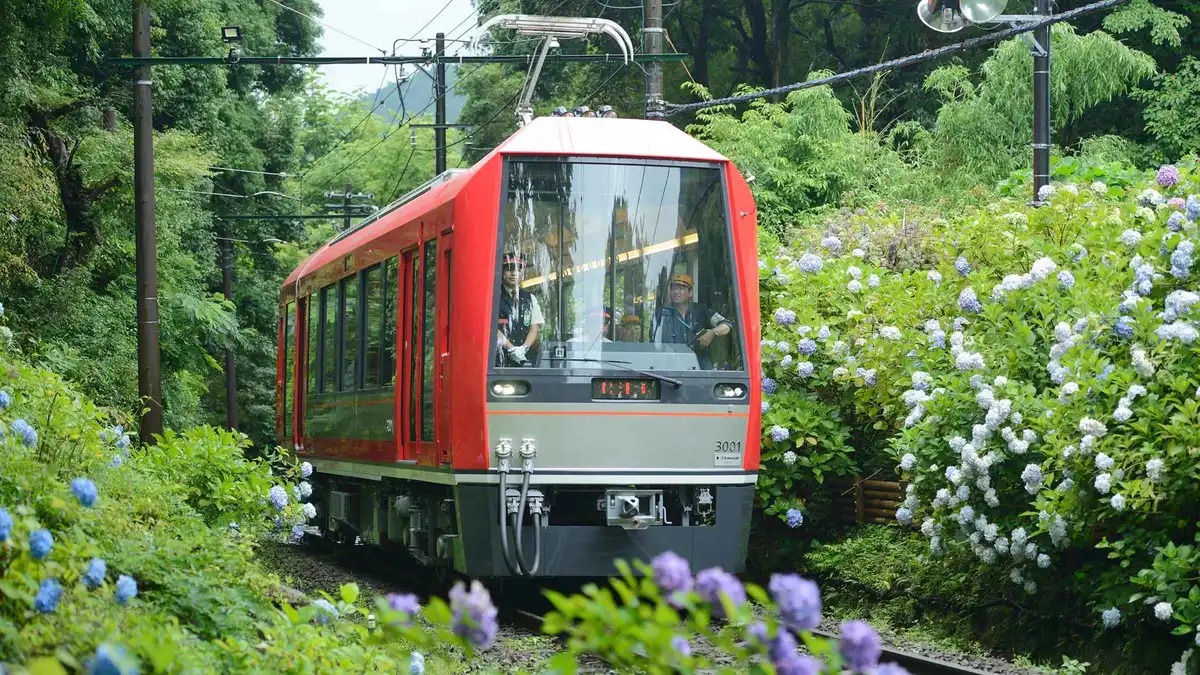
Hakone: Train Pass with Unlimited Rides & Activity Discounts
A self-guided 2 or 3 day transit pass covering the round trip from Shinjuku plus unlimited rides on Hakone's trains, cable car, ropeway and sightseeing cruise, with discounts at 70-plus local attractions.
Check Availability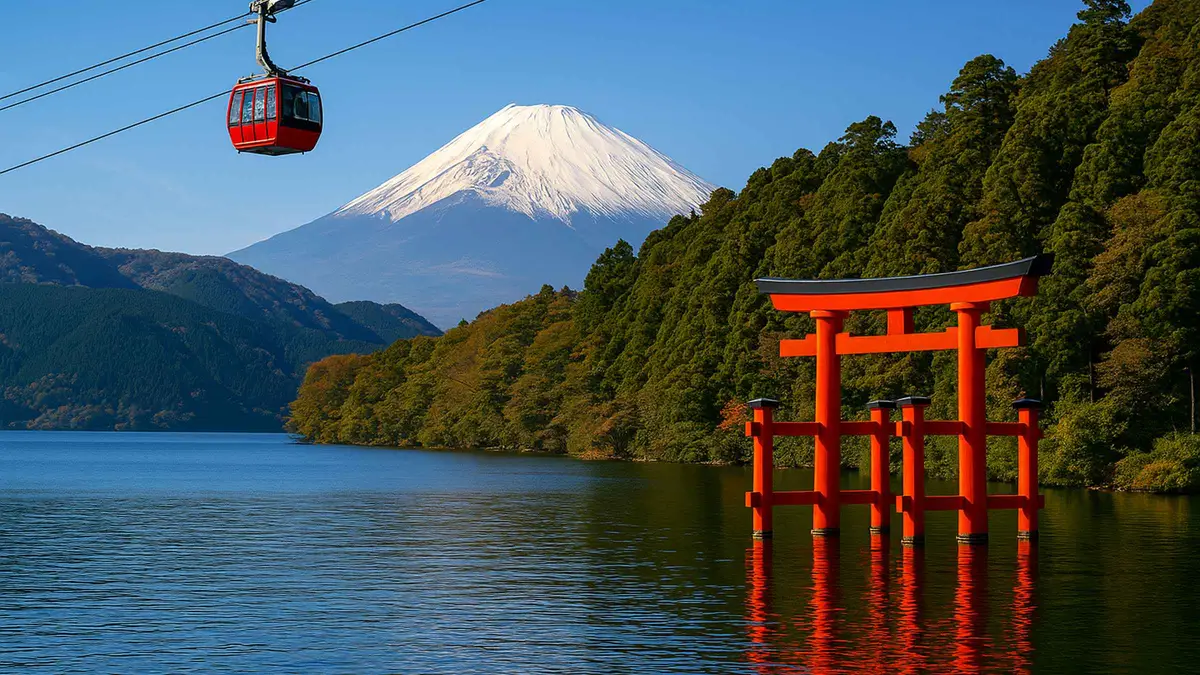 from $356.33
Tokyo: Hakone Full-Day Private Guided Tour with Pickup
A private full-day Hakone tour with pickup covering Lake Ashi, the ropeway, Owakudani Valley, Hakone Shrine, Sekisho Observatory and Gotemba Premium Outlets, at your own pace with a guide.
Check AvailabilityPrices, ratings and details are the platform's own, checked in Q3 2026; dollar figures are the listed prices — the platform bills in your account's currency.
What a Hakone day actually is: eight networks in one circle
Hakone is a town of about 11,000 people spread across 92.8 square kilometres of a volcanic caldera, and almost nothing in it is walkable from anything else. The trip works because eight transport operators are strung together in a ring.
The standard direction runs anticlockwise from the Tokyo end. You arrive at Hakone-Yumoto at the mouth of the valley, change to the Hakone Tozan Line, and climb to Gora on a railway that reverses direction three times because the gradient will not take a curve. At Gora a funicular takes over to Sounzan. At Sounzan the ropeway lifts you over the ridge, past the sulphur vents at Owakudani, and drops you at Togendai on the north shore of Lake Ashi. A boat done up as a pirate ship crosses the lake in 25 to 40 minutes to Moto-Hakone-ko or Hakone-machi-ko, where the old Tokaido checkpoint stood, and a Hakone Tozan bus takes you back down the valley to Hakone-Yumoto or straight to Odawara.
That is the whole trip. Each leg is short. What eats the day is the joins: six vehicles, six sets of steps, six timetables that do not know about each other.
Why the direction matters more than the itinerary
Everything on the mountain funnels the same way at the same hours, because everyone starts from Shinjuku on the same morning trains. Reversing the loop, taking a bus up from Odawara or Hakone-Yumoto to the lake and riding the ropeway and the mountain railway back down in the afternoon, puts you against the flow at the two pinch points. That is our reading of the geometry, not an operator recommendation, and the bus is covered by the same pass.
The one thing the loop is not
It is not a Mount Fuji viewpoint with a guarantee attached. Fuji shows over the lake on a clear cold morning and hides for weeks at a time, and neither Odakyu nor the ropeway operator publishes a visibility figure for Hakone. If the mountain is the point of the trip, the Fuji Five Lakes side has the odds published for it and this page does not.
Getting there: Romancecar, or the train that costs nothing extra
Odakyu runs both services out of Shinjuku on the same tracks. The difference is a reserved seat and forty minutes, and the operator prints both figures on its own Romancecar page, read in Q3 2026.
The Romancecar is a limited express: every seat is reserved, so a supplement is charged on top of the ordinary ticket or the pass. Odakyu quotes ¥1,200 one way from Shinjuku to Hakone-Yumoto and takes fifty yen off that for an e-ticket bought through its own app, and it puts the journey at about 80 minutes. On the Rapid Express and Express services, the operator says, there is standing space and few seats, no supplement is due, and the same run takes about two hours.
Seats open for sale at 10:00 one month before the departure date; refunds stop the moment the train leaves and cost ¥100 in handling.
| Way in | What you pay on top | Time to Hakone-Yumoto | Seat | Sold |
|---|---|---|---|---|
| Romancecar limited express | ¥1,200, about $7.78 (¥1,150 as an e-ticket, about $7.45) | About 80 minutes | Reserved, all seats | From 10:00 one month ahead, at Odakyu windows, machines and the operator's app |
| Express or Rapid Express | Nothing | About 2 hours | Not guaranteed; standing space, few seats | Any ticket machine, or free with the pass |
| Shinjuku round trip inside the Freepass | Included in ¥7,100 | As above, by whichever train you board | As above | Odakyu counters and app |
| Odawara start, arriving from the west | ¥6,000 pass + ¥910 single + ¥1,200 supplement = ¥8,110, about $52.60 | About 15 minutes onward to Hakone-Yumoto | Reserved only if seats remain on the day | Odakyu's own worked example on the pass page |
There is no bullet train to Hakone
No shinkansen serves the valley. Odakyu's own pass page frames the Odawara version as the product for travellers arriving from the Kansai direction, which is how a fast-train arrival joins the loop: reach Odawara, then take the Odakyu or Hakone Tozan services in. Odakyu publishes no shinkansen times, so this page prints none.
First and last departures are the gap in the operator's English pages. The timetable is published per train rather than as a first-and-last table, and we could not read one in Q3 2026. Check the departure board at Shinjuku on the day, and treat any Hakone plan that ends after dark as a plan that needs the times confirmed before you commit to it.
The Hakone Freepass, and the arithmetic that decides it
Every figure below is Odakyu's own, from the Hakone Freepass page and the Odakyu Hakone ropeway fare table read in Q3 2026, converted at ¥1,000 to $6.48. The pass is the single biggest decision of the day and the operator does not do the sums for you.
Start with what the pass is not: it is not a day ticket. The shortest version sold covers two days, and the operator is precise about what that means: the date of purchase counts as day one whatever time you buy, and validity ends after the last train and bus of the following day. Two days is not 48 hours.
A day tripper therefore buys a two-day pass and throws the second day away, which is the honest baseline for the comparison.
| Version | Adult | Approx. USD | Child | What it adds |
|---|---|---|---|---|
| Freepass, 2 days from Shinjuku | ¥7,100 | $46.00 | ¥1,600 | Round trip Shinjuku to Odawara plus all eight local networks |
| Freepass, 3 days from Shinjuku | ¥7,500 | $48.60 | ¥1,850 | The same, with a third day |
| Freepass, 2 days from Odawara | ¥6,000 | $38.90 | ¥1,500 | The local networks only; no Odakyu Line ticket |
| Freepass, 3 days from Odawara | ¥6,400 | $41.50 | ¥1,750 | The same, with a third day |
| Odakyu's own day-trip total | ¥9,500 | $61.60 | Not stated | Freepass from Shinjuku plus a Romancecar seat each way, ¥2,400 |
Where the pass earns its money
The Tokyo leg is easy to check. The gap between the Shinjuku pass and the Odawara pass is ¥1,100, and that gap buys a round trip Odakyu itself prices at ¥910 a single, or ¥1,820 for two. So the Shinjuku version delivers the journey out and back for about ¥720 less than buying the two tickets, before you have ridden anything on the mountain.
The mountain half is harder, and here the honest answer is a gap. The ropeway is the only local leg whose fare the operator group publishes as a plain table: a flat ¥2,000 one way and ¥3,000 return, regardless of which of the four stations you board or leave at. That single ride is a third of the ¥6,000 Odawara pass. The Hakone Tozan Line, the cable car, the sightseeing cruise and the Tozan buses do not publish comparable English fare tables that we could reach in Q3 2026, so nobody can print the exact number of legs at which the pass overtakes singles, and any page that does is guessing.
The rule we would actually use
Ride the ropeway in one direction and take the boat, the mountain railway and a bus in the same day and you are past the Odawara pass on the mountain alone, with the Shinjuku journey still to come. Skip the ropeway, or drive in and see one museum, and the pass is dead money. That is the whole test, and it turns on one question: are you doing the circle, or are you visiting one place inside it?
One more thing the pass quietly buys is insurance. The GetYourGuide listing for the same product notes that unused, unboarded transport can be refunded at the Odakyu Sightseeing Service Center if services are suspended in bad weather, which on this mountain is not a hypothetical.
How Much Time To Give Hakone
Only one number in this table is an operator's: the 80 minutes Odakyu quotes each way on the Romancecar. The rest are our routings, built from the leg order and the ropeway's published hours, and they assume you leave Shinjuku on a morning train.
The failure mode of a Hakone day is arriving at the ropeway after boarding stops. In February to November the last gondola boards at 17:00 and in December and January at 16:15, and the boat and the buses thin out behind it. Work backwards from that, not forwards from breakfast.
| Routing | Door to door from Shinjuku | What it skips | Rough cost |
|---|---|---|---|
| Ropeway and lake only | About 9 hours | The museums, the shrine walk, any onsen | ¥7,100 pass plus ¥2,400 of Romancecar seats |
| Full loop with the Open-Air Museum | About 11 hours | The far lake shore and the Hakone Checkpoint site | The same, plus ¥1,800 online museum admission |
| Overnight, one night in the valley | Two half days | Nothing; this is what the two-day pass was priced for | The same pass, plus a room |
If you only have the afternoon
Do not attempt the circle. Take the Romancecar out, ride the Tozan Line to Chokoku-no-Mori for the Open-Air Museum, which stays open to 17:00 with last entry at 16:30, and come back the way you came. The pass will not pay for itself on that plan, and single tickets are the right call even though we cannot print what they cost.
Hakone In Eight Dates
The valley was a checkpoint on the road to Edo long before it was a day trip, and two of the things you ride were built to move sightseers, not residents.
-
Heian period
The Hakone Gongen shrine appears in literature
The shrine on the lake shore is named in Heian-period writing, which makes it the oldest thing in the valley a visitor can still stand in front of.
-
1180
Minamoto no Yoritomo prays here after losing at Ishibashiyama
Beaten in the neighbouring town during the Genpei War, Yoritomo came to the shrine to pray for victory over his enemies. The lake shore has been a place people detour to ever since.
-
1603 to 1868
Hakone-juku and the checkpoint on the Tokaido
Under the Tokugawa shogunate every traveller on the highway between Edo and Kyoto was stopped at the Hakone barrier and had permits and baggage examined, to enforce the rules restricting the movement of women and weapons. The boat still lands beside the site.
-
August 1876
Hakone joins Kanagawa Prefecture
After a spell in the short-lived Ashigara Prefecture, the valley became part of Ashigarashimo District in Kanagawa, where it remains.
-
1889 and 1892
Town status, then the town as it is now
Hakone attained town status in 1889 and was settled as a town on 29 October 1892. The imperial household built a summer villa by the lake, and the valley became a resort for wealthy Tokyo and for the foreign settlement at Yokohama.
-
September 1956
Five neighbours merge in
The merger gave Hakone its present boundaries, 92.82 square kilometres of caldera, which is why the modern town is a string of resort villages rather than one settlement.
-
1970
The population peaks at 21,299
It has fallen every census since: 15,829 in 2000, 11,293 in 2020. The place that handles the day-trip crowds is a small town, and that is worth remembering when the last bus is full.
-
2017 to 2020
The valley becomes Tokyo-3
Hakone was listed as one of 88 anime pilgrimage sites for 2018 for its role as the fictional Tokyo-3, and station decorations went up again in 2020. If you cannot work out why a group is photographing a platform sign, this is why.
Dates and figures from the English Wikipedia article on Hakone, read in Q3 2026, which cites Japanese census data for the population series and the Hakone Tourist Association for the local crafts; the transport network order is Odakyu's own, from the Hakone Freepass page. Where Wikipedia gives a period rather than a year, we print the period.
The Open-Air Museum, and whether an onsen fits in a day
One stop on the Tozan Line is worth breaking the loop for. The other thing Hakone is famous for, the hot water, is the part a day trip usually gets wrong.
The Hakone Open-Air Museum sits at Chokoku-no-Mori station, one stop short of Gora, and it is the rare Japanese museum that publishes everything on one page. It opens 9:00 to 17:00, 365 days a year, with last admission half an hour before closing, so it is one of the few things in this guide that does not care what day of the week you turn up. Every figure below is from the museum's own visitor information, read in Q3 2026.
| Ticket | At the gate | Online | Approx. USD, online |
|---|---|---|---|
| Adults | ¥2,000 | ¥1,800 | $11.66 |
| University and high-school students | ¥1,600 | ¥1,400 | $9.07 |
| Middle and elementary school students | ¥800 | ¥600 | $3.89 |
| Disability certificate holders | ¥1,000 | Not sold online | $6.48 at the gate |
| Groups of 15 or more | ¥1,800 adult | Not applicable | $11.66 |
What the ticket gets you
About 120 sculptures stand on 70,000 square metres of hillside, so this is a walk rather than a gallery crawl. Wheelchairs and strollers are lent free at both information desks, the coin lockers take a ¥100 coin and give it back, and there is a footbath in the woods fed by the same hot springs as the hotels. Parking is ¥500 for three hours and ¥500 an hour after that, which is worth knowing only if the loop is not your plan.
The onsen question
Hakone is a spa town, which is the reason most Japanese visitors come and the reason the pass sells two days. The Freepass carries discounts at about 70 facilities including hot springs, museums and restaurants, per Odakyu's own description, but the operator does not publish which bath charges what, and no official day-use price list was reachable for this page in Q3 2026. So this guide does not print bath prices, and it will not print tattoo policies either, because they vary by house and nobody publishes them centrally.
The practical position for a day tripper: a bath is a 90-minute commitment on a day already made of connections, and it is the first thing to cut when the ropeway is running late. If the water is why you are coming, the honest answer is to stay the night and use the second day of the pass you have already paid for.
Five Things Most Visitors Do Not Know About Hakone
Each of these is argued above, and each ends in the source it came from.
- The ropeway fare is flat. Riding one stop from Sounzan to Owakudani costs the same ¥2,000 as riding the whole line to Togendai, because the operator charges by trip rather than by section (hakonenavi.jp ropeway fare page, read in Q3 2026).
- There is no one-day Freepass. Two days is the shortest sold, and the second day expires after the last service of the following day rather than 48 hours after purchase (odakyu-global.com discount-pass FAQ, read in Q3 2026).
- The Odawara version is not simply the pass without the train. Odakyu's own worked example for a traveller arriving from the west prices it at ¥6,000 plus a ¥910 single plus a ¥1,200 supplement, or ¥8,110 (odakyu-global.com Hakone Freepass page, read in Q3 2026).
- The Open-Air Museum charges ¥200 less for an online ticket than at the gate, and its coin lockers are free on a returnable ¥100 coin (hakone-oam.or.jp visitor information, read in Q3 2026).
- A Romancecar seat can be refunded until the moment the train departs, for a ¥100 handling fee, and is refunded automatically if the whole service is cancelled on an app ticket (odakyu-global.com Romancecar FAQ, read in Q3 2026).
On A Hakone Day: What To Do, And What Not To
Each line is a decision argued above, in the form you can act on at the ticket gate.
Do
- Buy the Romancecar seat as an e-ticket if you want one, which saves fifty yen and stops you queueing at the Shinjuku window
- Check the ropeway's live status banner before you leave Tokyo, because the operator posts suspensions and bus substitutions on it the same morning
- Work the day backwards from the last ropeway boarding, 17:00 from February to November and 16:15 in December and January
- Buy the Open-Air Museum ticket online if you are stopping there, for ¥200 off and no ticket queue
- Run the circle backwards from Odawara by bus if you are travelling at a weekend and would rather meet the crowd than join it
- Keep the wider destination list in mind if the forecast is wind: a lake day in a gale is a bus tour of fog
Don't
- Don't buy the pass for a plan that stops at one museum, because a single museum and two train rides will not reach ¥7,100
- Don't treat Owakudani as fixed: the crater stop is the leg most often bypassed by a replacement bus
- Don't assume a bullet train goes to Hakone, because none does; a fast-train arrival joins the loop at Odawara
- Don't plan a bath and the full loop on the same day trip, since the bath is the first thing a late connection removes
- Don't leave the return to chance: Odakyu publishes no first-and-last table in English, so read the board at Hakone-Yumoto when you arrive
- Don't count on a Fuji sighting from the lake; if the mountain is the point, give it its own day
What Breaks The Day: Volcanic Gas At Owakudani, Wind On The Ropeway
Hakone sits inside an active volcanic field in the Fuji-Hakone-Izu National Park, and the ropeway crosses the vents that make it worth seeing. Suspensions are routine rather than exceptional.
The pattern is consistent and the operator is open about it. When gas concentrations rise at Owakudani, or the wind gets above the gondolas' limit, the affected section is suspended and a replacement bus runs the passengers around it. The line as a whole rarely closes; the crater stop is what disappears. When we read the operator's status page in Q3 2026 it was carrying a suspension notice with a bus substitution for part of the line during inspection work, which tells you how normal this is.
So the rule is simple: never build the day around standing at Owakudani. Build it around the loop, and treat the vents and the black eggs boiled in the sulphur pools as the bonus you get on a still day. If you must have the crater, ride it early: the gas readings and the wind both tend to be worse later, and the substitution buses fill quickly.
What to check, and where
Two live sources, both the operator's own and both worth ten seconds before you leave your hotel: the status banner on hakonenavi.jp, which is the consolidated site for the Odakyu Hakone group covering the Tozan railway, the ropeway, the cruise and the buses, and the Odakyu app if you hold a Romancecar seat, since a fully cancelled service refunds an app ticket automatically.
The lake boat is the other soft spot. The operator's FAQ carries an entry on when the sightseeing cruise is suspended, which tells you it happens, but the answer did not load for us and no wind threshold is published. Assume the boat can go, and have the bus round the lake as a plan B; the pass covers both.
Hakone map: the loop, station by station
The circle in the order most visitors ride it, from the arrival station at the bottom of the valley to the lake and back. Positions come from the Wikipedia coordinates for each station and landmark; they are good enough to plan a day by, not to navigate with.
Coordinates read from the English Wikipedia entries for each station, landmark and lake in Q3 2026; the transport order is Odakyu's, from its Hakone Freepass network list.
Where to go instead, or next
Travel times are the operators' where they publish them and ours where they do not, which is most of the time.
Mount Fuji and Kawaguchiko
Hakone looks at Fuji when the air is clear; the Fuji Five Lakes sit under it. If the mountain itself is the reason for the trip, the Mount Fuji day has published visibility odds behind it and this one does not. The two make a poor pair in the same week.
The other side of the same mountainKamakura and the coast
The same railway company runs the coastal day trip, on a one-day pass rather than a two-day one. It is the trip to take when the Hakone forecast is wind, since almost everything at Kamakura is at sea level and on foot.
The other Odakyu dayThe full comparison
Time from which Tokyo station, one-way fare, the pass that covers it and how many hours it takes out of your day, for all six destinations side by side on the day trips hub.
Every destination on one tableHakone day trip questions
Can you do Hakone in one day from Tokyo?
Yes, and most visitors do. Odakyu puts Shinjuku to Hakone-Yumoto at about 80 minutes on the Romancecar, which leaves enough daylight for the full circle: mountain railway, cable car, ropeway, boat and bus. Our routing is about nine hours door to door for the ropeway and the lake, eleven if you stop at the Open-Air Museum. The awkward part is the pass, since the shortest Freepass sold covers two days and a day tripper wastes the second.
Is the Hakone Freepass worth it for a single day?
It depends on one thing: whether you ride the ropeway. That leg alone is a flat ¥2,000 one way or ¥3,000 return, about $12.96 or $19.44, and the boat, the mountain railway and the buses come on top. Do the whole circle and the ¥7,100 Shinjuku pass is comfortably ahead; visit one museum and go home and it is not. The exact break-even cannot be printed because four of the eight operators do not publish English single fares, and any page that gives you a precise number is inventing it. The self-guided pass card is listed at $46.10 against Odakyu's own ¥7,100.
How long is the bullet train from Tokyo to Hakone?
There is no bullet train to Hakone. No shinkansen serves the valley; Odakyu's own Romancecar covers Shinjuku to Hakone-Yumoto in about 80 minutes, and the operator frames its Odawara-start pass as the version for travellers arriving from the Kansai direction, which is how a fast-train arrival joins the loop. That version costs ¥6,000, plus ¥910 for the onward single and ¥1,200 if you want a reserved seat, per Odakyu's own example.
What is Owakudani, and how often does it close?
Owakudani is the ropeway's middle station, set among the sulphur vents of the caldera, and it closes at no notice for volcanic gas or high wind. The operator's normal response is a replacement bus over the affected section rather than a full shutdown, so the loop usually still works, minus the crater stop. Its live status page carried exactly such a notice when we read it in Q3 2026. Never make the vents the thing your day depends on.
Is Hakone a tourist trap?
It is heavily commercial and it is genuinely worth the fare, which are not contradictory. The valley is a working spa town of about 11,000 people inside a national park, and the ropeway over an active vent and the crossing of a caldera lake are not manufactured attractions. What is manufactured is the queue geometry: everybody rides the circle in the same direction at the same hours, which is why reversing it changes the day more than any other decision. The pirate ships are exactly as silly as they look.
Do you need to book a Hakone day trip in advance?
Only the seat. Romancecar tickets go on sale at 10:00 one month before the departure date and can be changed or refunded until the train leaves, minus ¥100. Nothing on the mountain is timed and no venue on the loop sells a slot, so the pass can be bought on the morning at the Odakyu Sightseeing Service Center. The reason to buy the pass ahead is the queue at Shinjuku, not availability.
Where A Hakone Day Fits In A Tokyo Trip
This is a third-visit-day trip masquerading as a first-visit one, and putting it in the wrong slot is how people end up disappointed by a good day out.
Do not spend day one or day two on it. The first days belong to Tokyo itself, and a nine-hour circle on six vehicles is a heavy way to start a trip while still adjusting to the time. Day four or five is the natural slot, once you can read a fare board without thinking about it.
A Monday works, and that is not a small point in this city. Nothing on the loop follows the Monday museum closure that shuts so much of Tokyo, and the Open-Air Museum states it opens 365 days a year, so a Hakone day is one of the cleanest answers to what is open on a Monday. Weekends are the opposite: the same trains, the same boats, the same buses, with the domestic crowd added.
One mountain per trip
Hakone and the Fuji Five Lakes sell the same photograph and cost the same day. Doing both in one week means two long transfers for one view, and the second one usually disappoints because you have already seen the better version of it. Pick the loop if you want the ride and the caldera; pick the Fuji side if you want the mountain in the frame and are willing to lose it to cloud.
The Hakone Loop On Film: Ropeway, Vents And Pirate Ships
Three run-throughs of the same circle, which is the fastest way to understand why the day is about connections rather than distance. Watch one before you decide how much of it to attempt.
A Classic Day Trip To Hakone from Tokyo
The standard loop in the standard direction, leg by leg, which is exactly the route this page prices.
Video: Japan GuideTHE Hakone Guide: Everything to Do in One Day!
A one-day version with the timings shown, useful for judging how much slack the ropeway leaves you.
Video: PiQtour JapanHakone Day Trip from Tokyo: Mt. Fuji Views, Hot Springs & Museums!
Covers the museum stop and the hot springs, the two things a tight loop usually cuts.
Video: Tokyo CheapoVideos load from YouTube only when you press play.
Reviewed Q3 2026 (July–September 2026); next review Q4 2026. Prices, hours and terms are set by the venue or operator and confirmed at checkout.
We may earn a commission if you book through one of our links, at no extra cost to you. Full affiliate disclosure