 Visit Tokyo Guide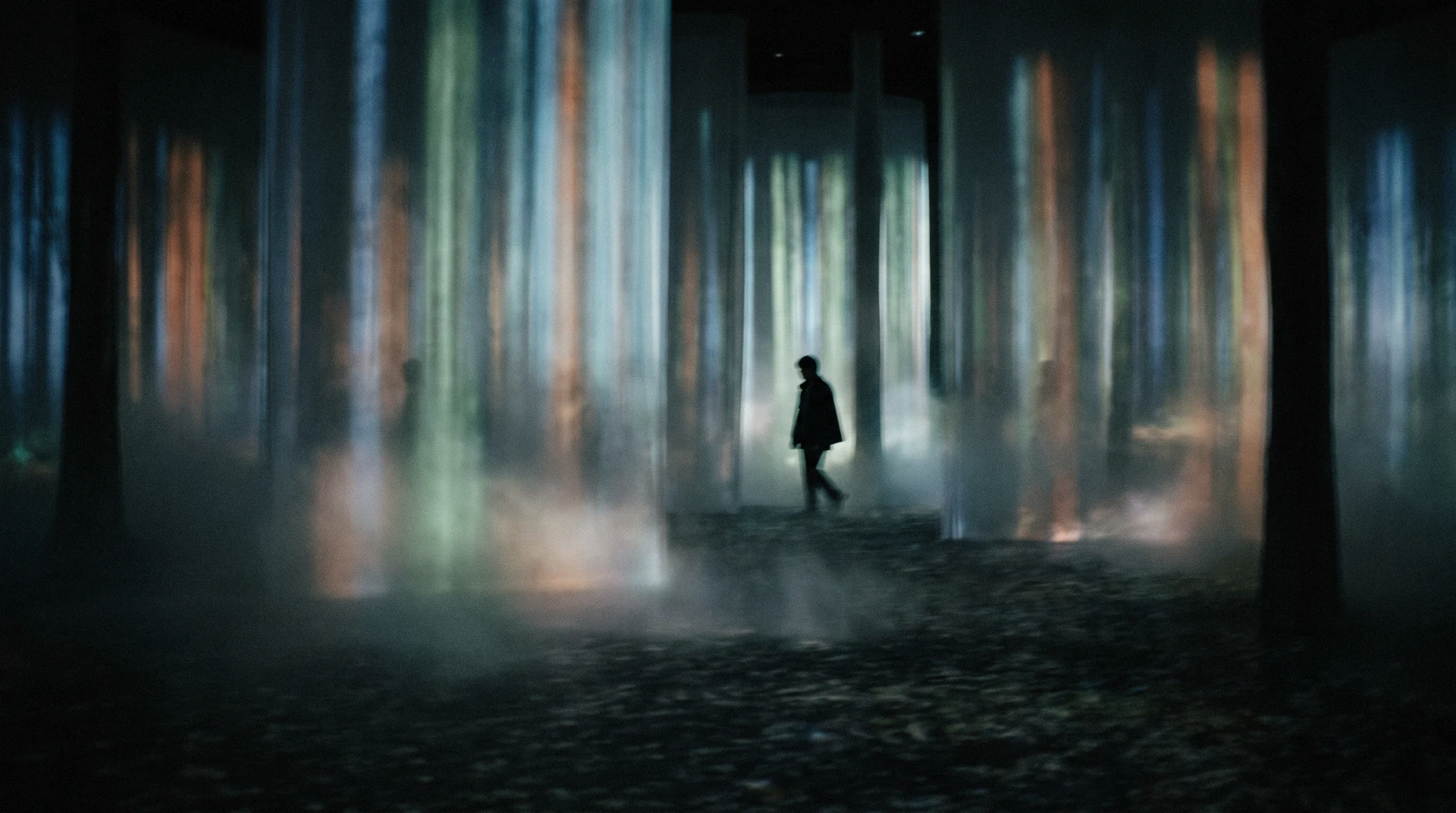
teamLab Borderless
teamLab Borderless is the digital art museum in the basement of Azabudai Hills in Minato City, open 08:30 to 21:00 on a standard day: a maze of dark rooms with no map, no route and no floor plan, where the artworks walk out of one space into another. It opened on 9 February 2024 and sells timed entry. This page covers what it is, how it differs in kind from the barefoot museum in Toyosu, the closed dates and the underground walk from Kamiyacho; what a slot costs at either venue is compared on the teamLab ticket page, and the trip around it is planned from the Tokyo guide index.
Quick answer What it is, how it differs, hours, how long
teamLab Borderless is a dark, dry, unmapped museum under Azabudai Hills, open 08:30 to 21:00 on a standard day with last entry an hour before closing. Artworks move between rooms rather than staying in them, and the museum deliberately gives out no floor plan, so finding a work is part of the visit. Entry is timed and the adult Entrance Pass starts at $23.30 (¥3,600).
Key takeaways
- This is not a bigger version of the Toyosu museum, it is a different kind of place: no water, no bare feet, no route. Which of the two suits you is argued below and priced on the teamLab ticket page
- The guided pairing with the Imperial Palace gardens is the version that gives the museum a context, and gets you 1.5 hours inside with the entry already held
- Buying on site costs $1.30 (¥200) more per ticket and is only possible if the day has not sold out, which on a weekend it usually has
- It closes on scattered Tuesdays rather than every one: Tuesday 8 September, Tuesday 20 October and Tuesday 24 November 2026 on the calendar we read, and it shuts early at 17:00 on 17 November
Key facts
Opening hours
| Standard days, daily | 08:30–21:00 |
|---|---|
| Extended dates, set per date | 08:30–22:00 |
| EN TEA HOUSE, inside | 09:00–20:30 |
Closed Tuesday 8 September, Tuesday 20 October and Tuesday 24 November 2026 on the calendar we read; the museum also closes at 17:00 on 17 November 2026. There is no weekly closed day
Admission
- Adult
- Entrance Pass from $23.30 (¥3,600) for 18 and over, with the venue's own note giving a dynamic range of ¥3,600 to ¥5,600; Flexible Pass $77.80 (¥12,000)
- Reduced
- $18.14 (¥2,800) age 13 to 17, $9.72 (¥1,500) age 4 to 12, $11.66 (¥1,800) with a disability certificate from any country plus one companion
- Free
- Children three and under
Planning it
- Time needed
- Not stated by the museum, which publishes no map and no route. Our routing: 90 minutes to two hours, and longer than that if you go back for rooms you lost
- Book ahead
- Essential — weeks ahead
- Address
- Azabudai Hills Garden Plaza B, B1, Minato-ku, Tokyo
Three ways in, read off the museum's own ticket page and off GetYourGuide in Q3 2026. The official site is the cheapest and the venue states that tickets are sold only there and on one authorised reseller; the guided rows buy the museum plus a reason to be in Minato City for the afternoon.
Do you want a fixed entry time at the lowest fare, or the freedom to walk in whenever you like?
| Option | Price | Includes | Cancel | Book |
|---|---|---|---|---|
| Entrance Pass, official siteAlmost everyone. The lowest fare and the full slot inventory, if you can commit to an hour | From $23.30 (¥3,600) adult, $9.72 (¥1,500) child | Timed entry, the full museum, free lockers | No cancellation; date and time changeable three times | Official site |
| Flexible Pass, official siteA day you cannot schedule, or a booking made before your flights are settled | $77.80 (¥12,000), adult or child | Any entry time on the chosen date up to last entry | No cancellation; date changeable three times | Official site |
| Museum and Imperial Palace gardens, guidedVisitors who want the contrast with old Tokyo built into the same afternoon | From $121.42 | Guide, skip-the-line entry, 1.5 hours inside, the East Gardens walk | Free up to 24 hours before | Check Availability |
| Museum, Azabudai Hills and the National Art CenterAnyone interested in the architecture around the museum as much as the museum | From $155.83 | Guide, skip-the-line entry, Roppongi public art, gallery entry | Free up to 24 hours before | Check Availability |
The gap between the first row and the last is $130 and it is not buying you a better museum: both guided options include the same entry ticket. What they buy is somebody to walk you between Azabudai Hills, Roppongi and the palace gardens, which is genuinely useful in a district that reads as a series of unconnected towers. If that is not the day you want, take the Entrance Pass and put the difference into a tour that goes somewhere else.
teamLab Borderless entry options compared
Two cards, both including museum entry and both linking to the operator's own calendar. Ratings and review counts are the platform's figures and the prices are the ones listed in Q3 2026.
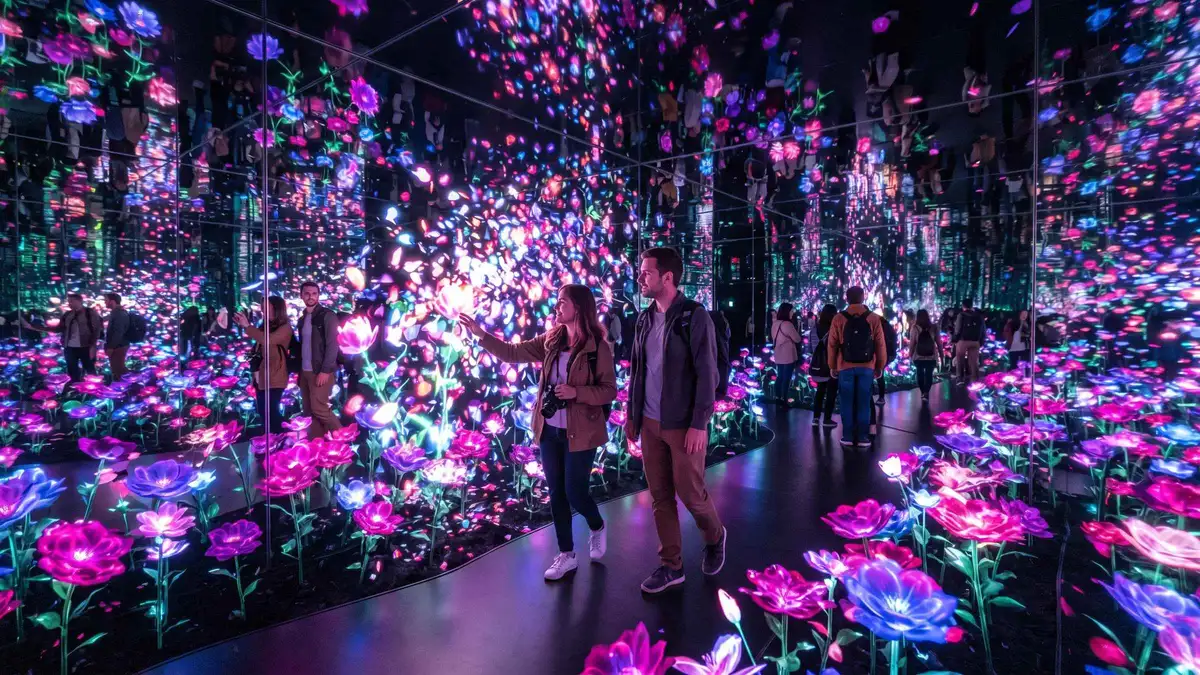 from $121.42
Tokyo: TeamLab Borderless & Imperial Palace History Tour
Pairs 1.5 hours inside teamLab Borderless with a guided walk through the Imperial Palace East Gardens and Nijubashi Bridge. Skip-the-line museum entry included. Suits travelers wanting modern art and Edo-era history together.
Check Availability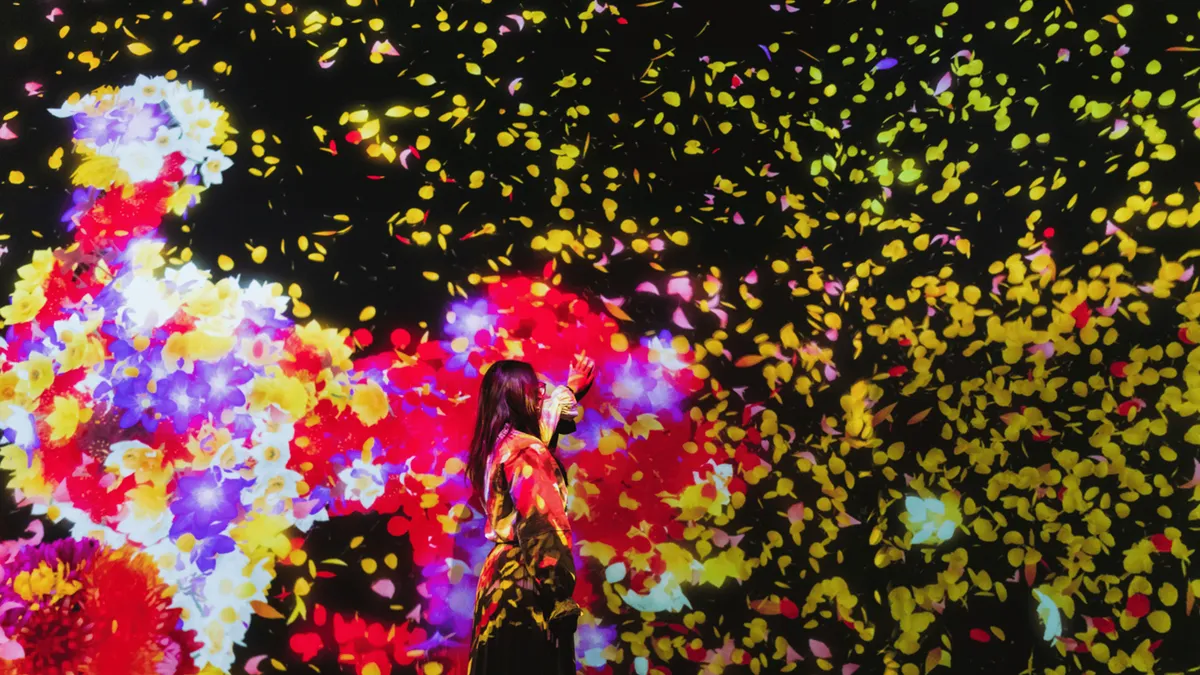 from $155.83
Tokyo: teamLab, Azabudai Hills & National Art Center Tour
Guided walk through Azabudai Hills' teamLab Borderless, then Roppongi Hills' public art and The National Art Center, Tokyo. Skip-the-line museum entry included. Suits travelers pairing digital art with architecture.
Check AvailabilityPrices, ratings and details are the platform's own, checked in Q3 2026; dollar figures are the listed prices — the platform bills in your account's currency.
A Museum That Refuses To Give You A Map
The absence of a floor plan is not a design oversight. It is the exhibit, and it is the thing that divides visitors.
The museum's own answer to the question of whether it hands out maps is short and unapologetic: it is a world of art without boundaries, a museum without a map, and no maps are provided so that visitors experience the art in line with that concept. What that means on the floor is that works do not stay put. A flock of projected birds leaves one room and appears in another; a river of light runs under a doorway and continues on the far side; two works meet in a corridor and interfere with each other.
You find things by wandering, and you lose things the same way.
What is actually in there
Universe of Water Particles on a Rock where People Gather is the waterfall wall that people stand in front of and divert with their bodies. Bubble Universe is the mirrored sphere room that most photographs of the museum come from. Light Sculpture - Flow builds sculptures out of moving rays of light rather than out of material, and it currently hosts a show called On the Asymmetry of the Universe, with two new series in which a form exists either only in the mirror or only outside it.
There is also a tea house, EN TEA HOUSE, where flowers bloom inside the bowl as you drink, and a Sketch Ocean where a fish you draw is scanned and released into the projected sea.
It sits underneath a shopping complex
The entrance is on basement level one of Garden Plaza B in Azabudai Hills, the Mori development that opened in Minato City in 2023. Both nearby stations connect to it through an underground passage, so you can arrive without going up to street level, which in a Tokyo August is a real consideration. The Sketch Factory, where a drawing is turned into a badge, a towel or a tote bag, is outside the museum proper, so you can use it without a ticket.
teamLab Borderless In Six Dates
The museum is two years old in its current form and has already moved once, which is the fact that most out-of-date guides get wrong.
-
2001
teamLab is founded
An interdisciplinary collective of artists, programmers, engineers, animators, mathematicians and architects.
-
June 2018
The first Borderless opens on Odaiba
The original Mori Building Digital Art Museum, on the bay-side island, established the no-map format.
-
August 2022
The Odaiba site closes
The venue shuts with no immediate replacement, which is why English-language articles about it describe a building that no longer holds the collection.
-
9 February 2024
Borderless reopens at Azabudai Hills
In the basement of Garden Plaza B, in the Mori development in Minato City. The venue's own general information gives the term as permanent, not a limited run.
-
2025
Light Sculpture - Flow is added
A room in which sculpture is made out of moving light rather than matter, hosting the current On the Asymmetry of the Universe exhibition.
-
Now
Two teamLab venues, two tickets
The Toyosu museum runs to the end of 2027 on its published exhibition period; this one is open-ended. Neither ticket admits you to the other.
Dates from the museum's own page, teamlab.art/e/tokyo/, and from the Wikidata item Q131314431, read for this guide in Q3 2026. That item carries no English Wikipedia sitelink, and the existing English article describes the closed Odaiba venue, so it is deliberately not linked here.
How It Differs From The Barefoot Museum, In Kind Rather Than Degree
The two venues share a name and a collective and almost nothing else. The comparison below is built from what each one publishes about itself, not from a preference.
The short version: Toyosu is a route through water that you walk barefoot in about ninety minutes, and Azabudai is a dark maze with no route that you can lose two hours in without noticing. Toyosu is physical and legible; Azabudai is disorienting on purpose. Neither ticket admits you to the other, and there is no combined ticket, which is the first thing most people ask.
| This museum, Azabudai Hills | The Toyosu museum | |
|---|---|---|
| Format | Unmapped maze, works move between rooms | One-way route through set rooms |
| Water | None; you stay dry and keep your shoes on | Knee-deep in places, barefoot throughout |
| Hours | 08:30 to 21:00 standard | 08:00 to 22:00 |
| Adult entry from | $23.30 (¥3,600), dynamic to ¥5,600 | $23.30 (¥3,600), dynamic by date |
| Sold at the door | Yes if not sold out, at $1.30 (¥200) more | Never, in any circumstance |
Which suits which visitor
Take this one if you like being lost, if you are travelling with a photographer, if you would rather not take your shoes off, or if you are staying anywhere in Minato City and the bay is a trek. Take the Toyosu museum if you have children old enough to enjoy getting wet, if you want the experience to be physical rather than visual, or if you can pair it with the fish market in the same morning. If you have time for exactly one and no strong preference, this is the one with the shorter journey attached for most visitors, and the Toyosu one is the one people describe for longer afterwards.
The children's argument
Both venues have a physical half aimed at children, and they are not the same. The catching and collecting rooms, where an app lets children find and collect creatures in the space, are at the Toyosu venue alongside its Athletics Forest. This museum has no equivalent children's zone: what it has is a dark, low-ceilinged, uneven floor plan and a firm published warning to watch children closely, plus a rule of one adult per five children of elementary age or below.
For under-eights, the barefoot museum is usually the better afternoon, and the Tokyo with kids page sets out the alternatives.
How Much Time To Give teamLab Borderless
The museum publishes no visit length, no map and no route, so any figure is an estimate. These three are ours, measured from the entrance queue.
The variable that makes this venue different from every other museum on this site is that you cannot audit your own progress. There is no plan to tick off, so people either leave after an hour convinced they saw it or stay three hours looking for a room somebody mentioned. Decide in advance which of those you are.
| Routing | Door to door | What you get | What it skips |
|---|---|---|---|
| One pass through | About 75 minutes | The waterfall wall, the mirrored sphere room, whatever else you happen upon | Most of it, by design |
| Wander until it repeats | About 2 hours | The main halls twice, the light sculpture room, the corridors where works meet | The tea house sitting |
| With the tea house and a second look | 2.5 to 3 hours | All of the above plus a bowl at EN TEA HOUSE and the Sketch Ocean | Nothing inside |
The tea house is a separate decision
EN TEA HOUSE opens thirty minutes after the museum and takes last orders thirty minutes before it closes, which on a 22:00 date means last orders at 21:00. Every visitor at the table must order at least one drink. It is inside the ticketed area, so it costs you nothing to walk past and see whether there is a queue.
There is no time limit, and no re-entry
The museum states both plainly: there is no limit on how long you stay after admission, and once you leave you cannot come back in. So the practical advice is to eat before you go in, use the toilets inside rather than out, and treat the exit as final.
Hours, The Scattered Tuesday Closures And The Early Day
The pattern here is not weekly, and it is the thing to check before you book anything else around it.
Standard hours are 08:30 to 21:00, with last entry one hour before closing. Reading the museum's own calendar in Q3 2026, the closures are Tuesday 8 September, Tuesday 20 October and Tuesday 24 November 2026, which is roughly monthly rather than weekly. The museum also closes at 17:00 on 17 November, and runs an extended 22:00 closing on a long list of October and early November dates: 1 and 2, 5 to 9, 12 to 16, 19, 21 to 23 and 26 to 30 October, and 2, 5, 6, 9, 12 and 13 November.
Which slot to take
The 08:30 opening is the only reliably quiet hour, and in a museum where the works move between rooms an empty room is a genuinely different experience: the projections respond to whoever is present, so with two people in a hall the piece is about you and with forty it is about the crowd. The last two hours are the second option. Because the fare is set by date rather than hour, an early slot costs nothing extra.
What the ticket does not promise
Individual artworks may be unavailable because of crowds or maintenance, and the works change with the season, both of which the museum states in its own notes. A refund is available only if the museum has an unscheduled closure, and even then it will not cover your transport. If a specific room is the reason you are going, check the museum's own news page rather than a photograph on a booking site.
Lockers, Children, Cameras And What You Cannot Bring In
The venue is dark, mirrored and low-ceilinged, and its rules follow from that rather than from museum convention.
- Free lockers are provided; anything over 50 centimetres and every buggy goes to the luggage room instead
- Drinks without caps, strongly scented items, fresh flowers and anything staff judge dangerous are refused at the door
- Food cannot be brought in, sweets and chewing gum included. Drinks are allowed
- Photographs and video are welcome and may be posted, but no flash, and nothing over 30 centimetres: no tripods, monopods or selfie sticks
- Skirts and mirrored floors do not combine, and a wrap skirt is kept beside the artworks where this matters
- Children of elementary age or below need an adult of 18 or over, one adult for every five children, and child harnesses are asked against for safety
Accessibility, and what is genuinely open
Wheelchair and stretcher access is by lift, and the museum publishes the dimensions: a 1,000 millimetre entrance width and a 1,600 by 1,350 millimetre car. Stretchers that fit those dimensions can enter; larger ones mean transferring to a chair. Some works cannot be entered in a wheelchair and are viewed from a designated area, and the number of wheelchair users admitted at once is capped, so there may be a wait.
Senior carts and electric chairs that cannot be held under 2 km per hour must be swapped for a house chair. Canes are fine. There are two rest areas and no nursing room.
The disability ticket is unusually open
The discounted ticket applies to a certificate holder and one companion, the certificate may be issued by any country, and the Mirailo ID app is accepted in place of a physical certificate. That is a materially wider rule than the Skytree's, which limits its own discount to certificates issued in Japan. Both people must enter at the same time, because the certificate is checked at the gate.
Getting To Azabudai Hills, And The Underground Route
Two stations, both connected to the museum without going outside, and a car park rule that saves money if you drive.
Kamiyacho Station on the Tokyo Metro Hibiya Line, Exit 5, is two minutes on foot. Roppongi-Itchome on the Namboku Line, Exit 4, is six. The museum states that both are linked to the building by underground passage and that you can follow the signs the whole way without surfacing, which is worth knowing in rain or in the August heat.
The entrance itself is on basement level one of Garden Plaza B, which is a specific address in a large complex: aim for Garden Plaza B rather than for Azabudai Hills generally.
If you drive
The museum has no car park of its own and directs drivers to the Azabudai Hills P6 car park; take the D lift to B1 and the entrance is immediately on the left. If you have already bought your ticket online, present the parking ticket at the information counter for a discount, which is not offered automatically.
Where it sits in the city
This is Minato City, ten minutes from Roppongi and fifteen from Ginza, which puts it within a short ride of most business-district hotels. The older broadcasting tower is a fifteen-minute walk south and makes the obvious pairing for an evening; the transfers themselves are covered on the getting around page.
Five Things Most Visitors Do Not Know About teamLab Borderless
All five come off the museum's own pages, and none of them is on the ticket.
- There is no map and there never will be; the museum states that none is provided so visitors experience the art in line with the concept (museum FAQ, teamlab.art/e/tokyo/)
- Tickets are sold on the official ticket site and one authorised reseller only, and on-site sales carry a ¥200 surcharge and exist only while stock lasts (museum ticket notes, teamlab.art/e/tokyo/)
- A disability certificate issued by any country is accepted, and so is the Mirailo ID app in place of a physical one (museum ticket notes)
- Guides, escorts and group attendants must buy a ticket like anyone else, whatever credentials they hold (museum ticket notes)
- Flashing shoes, light-up bracelets and glow sticks are refused, because they interfere with other visitors' view of light-based works (museum visitor notes)
The last one sounds trivial until you are standing in a dark hall watching a light sculpture with a child's trainers strobing across the floor. It is the clearest single sign that the museum has thought about what it is showing and what will ruin it.
At teamLab Borderless: What To Do, And What Not To
Every line here is a decision argued above, in the form you can act on that morning.
Do
- Take the 08:30 slot if an empty room matters to you, because the works respond to whoever is in them
- Follow the underground signs from Kamiyacho Exit 5 rather than walking up to street level and around the complex
- Decide before you go in whether you are doing one pass or wandering until it repeats, since there is no map to tell you which you have done
- Wear something you can move in and skip the short skirt, or take the wrap skirt kept by the mirrored floors
- Buy on the official site rather than at the door, which adds $1.30 (¥200) per ticket and depends on stock
- Consider the guided pairing with the palace gardens if a couple of hours of dark rooms is all you want of the day
Don't
- Don't turn up on a Tuesday without checking; the closures are scattered Tuesdays rather than every one
- Don't book 17 November expecting an evening visit, when the museum closes at 17:00
- Don't step out for air planning to return; re-entry is not permitted
- Don't bring food, sweets or an uncapped drink, all of which are refused at the door
- Don't expect a refund for a room being shut; artworks can be unavailable for crowds or maintenance and only an unscheduled closure of the whole museum is refundable
- Don't assume this ticket covers the barefoot museum in Toyosu. They are two venues and two tickets, and no combined ticket exists
teamLab Borderless map: the entrance, the stations and what is nearby
The museum entrance in Garden Plaza B, the two stations that connect to it underground, and the two places within a twenty-minute walk that make an evening of it.
The museum coordinate is its own published position; the station pins follow the venue's access page walking times and the two neighbours their own published addresses, read in Q3 2026.
Next stop from teamLab Borderless
Walk times are ours, from the Garden Plaza B entrance. Minato City is spread out, so these three are the ones that are genuinely walkable rather than merely close on a map.
Tokyo Tower
The orange lattice tower in Shiba-koen, 333 metres, with a Main Deck open until 23:00 and no closed day. It is the obvious evening after an afternoon underground, and it is the one high view in the city that stays open late enough to catch after a 21:00 museum closing. Fares and decks on the Tokyo Tower page.
15 min walk southGinza
The Hibiya Line runs straight there from the station above the museum. Ginza is where the evening goes if you want dinner and a department-store food hall rather than another attraction, and it is open late in a way that most of the city is not.
About 10 minutes by train from KamiyachoMuseums in Tokyo
The National Art Center and the Mori Art Museum are both a walk away in Roppongi, which makes this corner of the city the densest art district in Tokyo. Which of them is open on your day, and which shut on Tuesdays, is set out on the museums hub.
20 min walk to RoppongiteamLab Borderless questions
Is teamLab Borderless worth the hype?
It is worth it if you want to be disoriented and photographed inside the work, and it is not if you want to understand what you are looking at. The museum gives out no map on purpose, works move between rooms, and there is no way to know what you have missed. That is either the best thing about it or an irritation, and honest visitors split about evenly. What is not in dispute is that the mirrored halls are unlike anything else in Tokyo, and that they are ruined by a full room, which is the argument for the 08:30 slot.
What are teamLab Borderless hours, and which days is it closed?
08:30 to 21:00 on a standard day, with last entry an hour before closing. The closures are scattered rather than weekly: reading the museum's own calendar in Q3 2026, they are Tuesday 8 September, Tuesday 20 October and Tuesday 24 November 2026. It closes early at 17:00 on 17 November and stays open to 22:00 on a long list of October and early November dates. The tea house inside opens half an hour after the museum and takes last orders half an hour before it shuts.
How long do you need at teamLab Borderless?
The museum publishes no figure, and because there is no map you cannot measure your own progress. Our routing is about 75 minutes for one pass through, two hours to wander until the rooms start repeating, and closer to three with the tea house and a second look at the halls you liked. There is no time limit once you are inside, but there is no re-entry either, so eat first. The guided visit with the palace gardens allocates 1.5 hours inside, which is a fair working figure.
Can I buy a ticket on the day at teamLab Borderless?
Sometimes. Same-day tickets are sold through the official ticket website if the date has not sold out, and on site at a different price: the museum states a $1.30 (¥200) surcharge for buying at the venue and that on-site sales run only while stock lasts. Weekend and holiday dates routinely sell out, so this is not a plan. Tickets cannot be cancelled once bought, though a date and time bought on the official site can be changed three times, up to two hours before the slot. The full price comparison is on the teamLab ticket page.
Which teamLab museum should I visit if I only have time for one?
Choose by what you want the visit to feel like rather than by which is better. This one is dry, dark, unmapped and about getting lost; you keep your shoes on and you leave with photographs. The Toyosu museum is barefoot, physical and routed, with knee-deep water and mirrored floors, and it is the one families with older children usually prefer. Neither ticket admits you to the other and no combined ticket exists. If your hotel is anywhere central, this one is the shorter journey.
Is teamLab Borderless suitable for children?
For older children, yes. For toddlers it is harder work than it looks: the rooms are dark with low ceilings and uneven floors, there is no children's zone here, and the museum asks parents to keep children close and specifically asks against child harnesses. Children of elementary age or below must be with an adult of 18 or over, at one adult per five children, and under-threes go free. Buggies go to the luggage room. Families with small children usually do better at the barefoot museum, and the Tokyo with kids page covers what else works.
Where teamLab Borderless Fits In A Tokyo Day
Two hours underground in the middle of a day is a strange shape, so this visit works best at one of the two ends.
The morning version is the better one: an 08:30 slot, out around 10:30, and the whole day still ahead of you with the quietest possible version of the museum behind you. From Kamiyacho you are ten minutes from Ginza, fifteen on foot from Tokyo Tower and twenty from the Roppongi galleries, so nothing about the rest of the day is constrained.
The evening version trades the quiet for convenience: a 19:00 slot after a full day, out at closing, and dinner in Azabudai Hills or Roppongi afterwards. It is the one to take if you are already staying in Minato City. What we would not do is book it for the middle of an afternoon, when the halls are at their fullest and a museum whose works respond to the people in the room becomes a museum about queuing.
The two-day itinerary places it at an end rather than in the middle.
teamLab Borderless On Film: The Halls, The Tea House And The Maze
Three walk-throughs of the Azabudai Hills museum, filmed since it moved, which rules out most of what is on YouTube under this name.
TeamLab Borderless: Tips & Walk-through (Azabudai Hills)
A practical walk-through of the current venue, covering what to expect at the entrance and inside the main halls.
Video: Cakes with FacesThe New TeamLab Borderless in Azabudai Hills, Tokyo | Guide & Full Walkthrough
A full walk of the maze at real pace, which is the clearest way to judge how long you would want inside.
Video: Tour From Home TVJapan Food Tour of Newest Must-Visit Tokyo Spot Azabudai Hills & teamLab
Covers the complex the museum sits under, which decides where you eat before or after your slot.
Video: Paolo fromTOKYOVideos load from YouTube only when you press play.
Reviewed Q3 2026 (July–September 2026); next review Q4 2026. Prices, hours and terms are set by the venue or operator and confirmed at checkout.
We may earn a commission if you book through one of our links, at no extra cost to you. Full affiliate disclosure