 Visit Tokyo Guide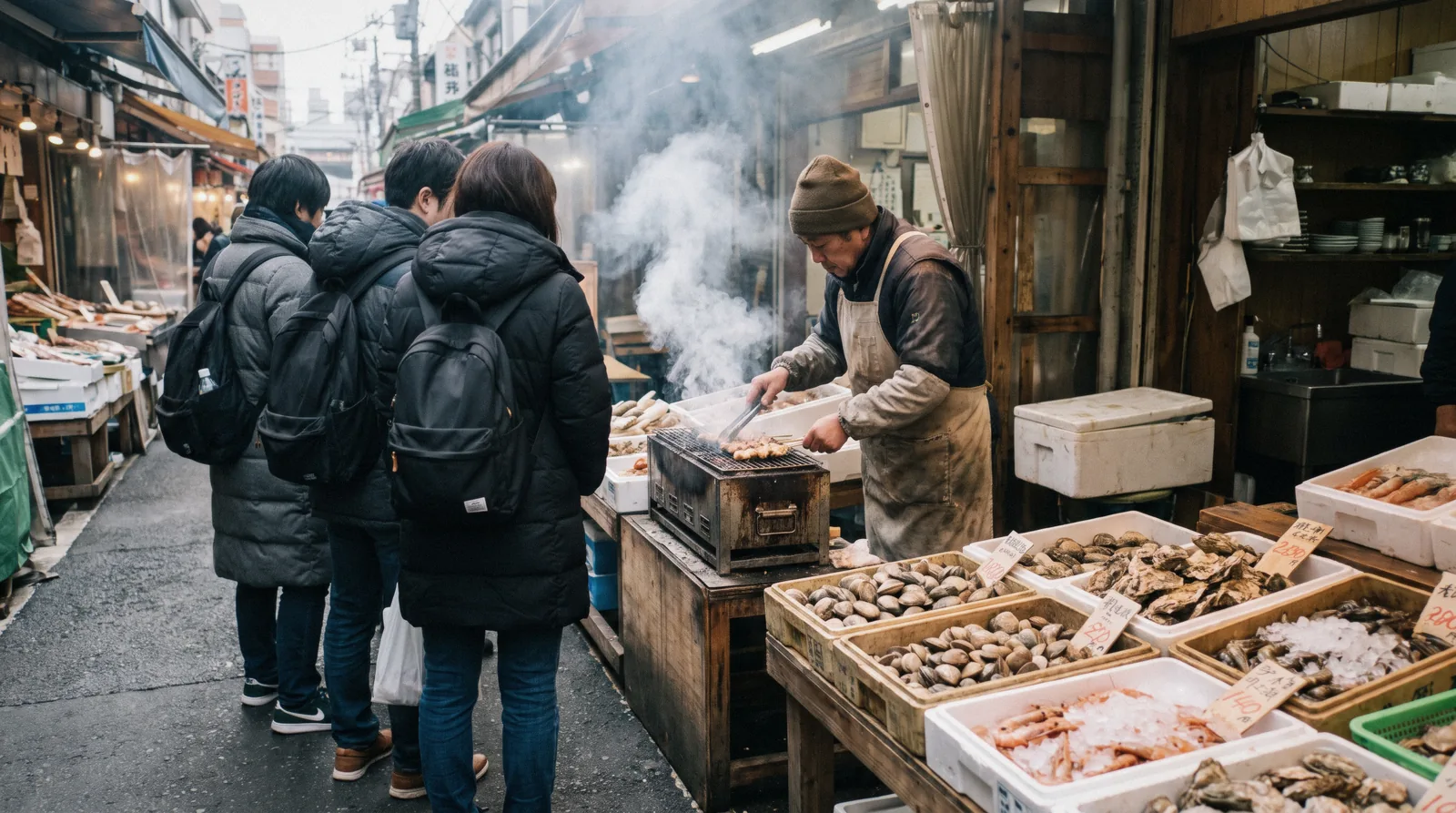
Tsukiji Outer Market
The Tsukiji Outer Market is the block of roughly 460 shops, stalls and small restaurants in Chuo-ku that stayed put when the wholesale trade left. It is free to walk into, there is no ticket and no gate, and the whole thing runs on a morning rhythm: professional buyers first, visitors afterwards, most shutters down by early afternoon. This page covers the hours, the closure calendar, the eating rule, the cash question and the walk from each station. Where the auction went, and what a 05:00 start there gets you, is on the Toyosu page; the wider price ladder for eating in the city is on where to eat in Tokyo. Where a market morning fits in a wider trip is set out on the Tokyo city guide.
Quick answer Free entry, the hours that matter, the eating rule, in three lines
The Tsukiji Outer Market is free, has no gate and no ticket, and about 460 shops trade there on a morning schedule that is largely finished by 14:00. The market's own house rule gives professional buyers priority until 09:00, which makes 09:00 to 11:00 the window a visitor actually wants.
Key takeaways
- There is no market-wide opening time to look up. Shops follow the wholesale market's closure calendar, which shuts Sundays, most Wednesdays and national holidays, and the operator says plainly that shop days still vary; the closure calendar section has the September pattern counted out
- Eating is the point, but not while walking: the market asks you to eat inside the shop or directly in front of it. A two-hour guided walk is the cheapest way to be shown which counters do what, and a food walk with five tastings settles the ordering problem for you
- The tuna auction is not here. It moved with the wholesale trade, and watching it means a 05:00 start at Toyosu on the other side of the bay
Key facts
Opening hours
| Plat Tsukiji information centre, Mon-Sat | 08:00–14:00 |
|---|---|
| Plat Tsukiji information centre, Sun, holidays and market closure days | 10:00–14:00 |
| Public lounge, Mon-Sat | 06:00–16:00 |
| Public lounge, Sun, holidays and market closure days | 07:00–16:00 |
Closed Sundays, most Wednesdays and national holidays on the Tokyo Metropolitan Central Wholesale Market calendar the market publishes; the operator states in its own footnote that some outer-market shops close on those days and that each shop's days must be confirmed with the shop. The information centre and public lounge also close over the year-end and New Year holidays.
Admission
- Adult
- Free. There is no admission charge to any street in the market
- Reduced
- Not applicable
- Free
- The whole market, including Namiyoke Inari Shrine at its eastern end
Planning it
- Time needed
- Not stated by the market; our routing: 75 minutes to walk and eat, 2 to 2.5 hours if you shop for knives or dried goods
- Book ahead
- Optional — walk-up usually fine
- Address
- Tsukiji 4-chome and the blocks around Harumi-dori and Shin-Ohashi-dori, Chuo-ku, Tokyo. The market publishes no single street address for itself
There is no ticket to compare, which makes this table unusual: the first row is the market itself, free and unbookable, and the rows under it are the guided options priced on GetYourGuide when we read them. Platform prices are per person and move with the date, so treat them as the figure you check at the operator's calendar rather than the figure you pay.
Nothing here costs money to enter, so the only question is whether you want someone to order for you.
| Option | Price | What it covers | Cancel | Book |
|---|---|---|---|---|
| Walk in yourselfAnyone happy to point at things. The market is 300 metres end to end and impossible to get lost in | Free | Every street, every shop front, the shrine, the information centre | Nothing to cancel | Official site |
| Guided walking tour, 2 hoursFirst-timers who want the layout explained and will then eat on their own | $12.99 | A guide through the lanes, what each shop sells, no tastings included | Free up to 24 hours before | Check Availability |
| Small tour with a local guideReaders comparing the two cheap walks; this one carries the higher rating of the pair | $12.99 | The same walk with a resident guide, questions answered in English | Free up to 24 hours before | Check Availability |
| Food walking tour, 3 hours, 5 tastingsAnyone who does not want to queue twice and read a Japanese menu three times | $97.40 | Five tastings ordered and paid for you, plus the walk | Free up to 24 hours before | Check Availability |
| Auction at Toyosu plus this marketThe 05:00 crowd. It buys the one thing this market genuinely cannot give you | $118.17 | The early auction viewing across the bay, then breakfast in these lanes | Free up to 24 hours before | Check Availability |
The market itself sells nothing and takes no commission; the free row is the honest default and the reason this page leads with it. Guided options are listed with GetYourGuide's own prices, read in Q3 2026. We earn a commission if you book through the paid rows, at no extra cost to you.
Guided walks through the market, compared
Each card links to the operator's own page, where the calendar shows which mornings still have space. Prices are the platform's own listing in US dollars, read in Q3 2026, and every one of these walks starts inside or beside the market rather than at a hotel.
 from $12.99
Tokyo: Tsukiji Fish Market Guided Walking Tour
A guided 2-hour walk through Tsukiji Outer Market and Tsukiji Hongan-ji Temple with a small group capped at 10. Food and drinks are extra, so bring cash for tastings along the way.
Check Availability from $12.99
Tsukiji Market: Tour with a Local Guide
A 1.5-hour Tsukiji Outer Market walk with a local guide who points out wasabi, tuna and Wagyu stalls. Food is pay-as-you-go, not included, and the route is wheelchair accessible.
Check Availability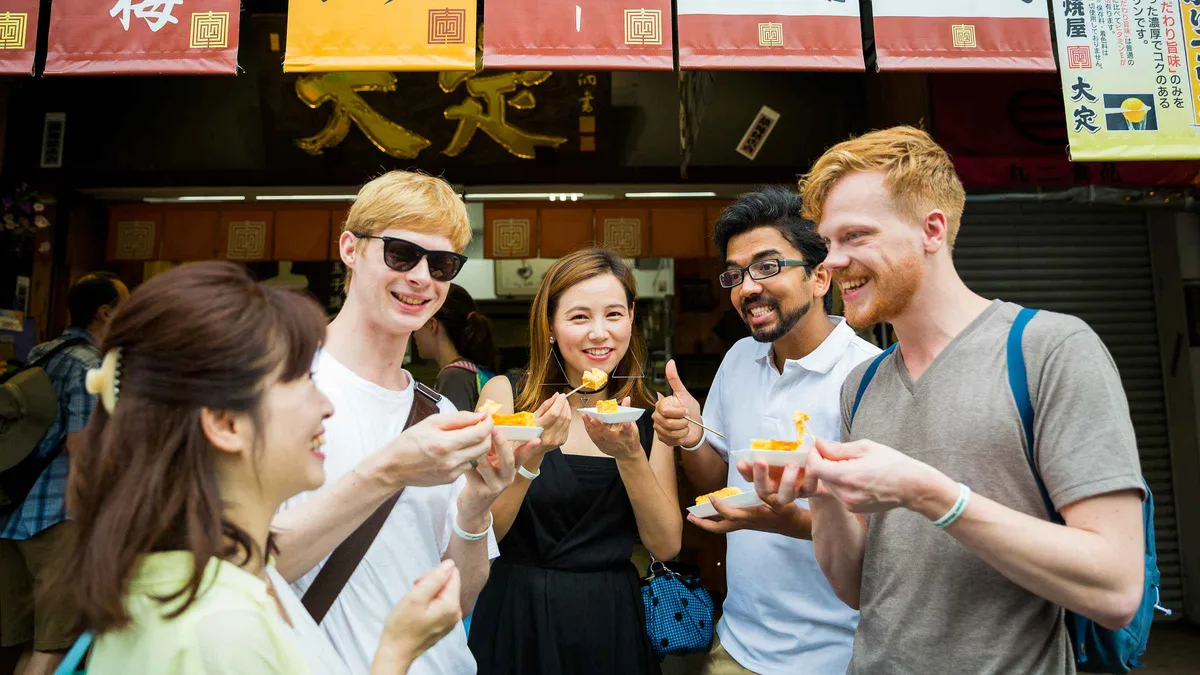 from $97.40
Tokyo: Tsukiji Fish Market Food Walking Tour with 5 Tastings
A 3-hour small-group food walk through Tsukiji Outer Market with five tastings including Wagyu beef skewers and sushi or a seafood bowl. Not suitable for vegetarians, vegans or wheelchair users.
Check Availability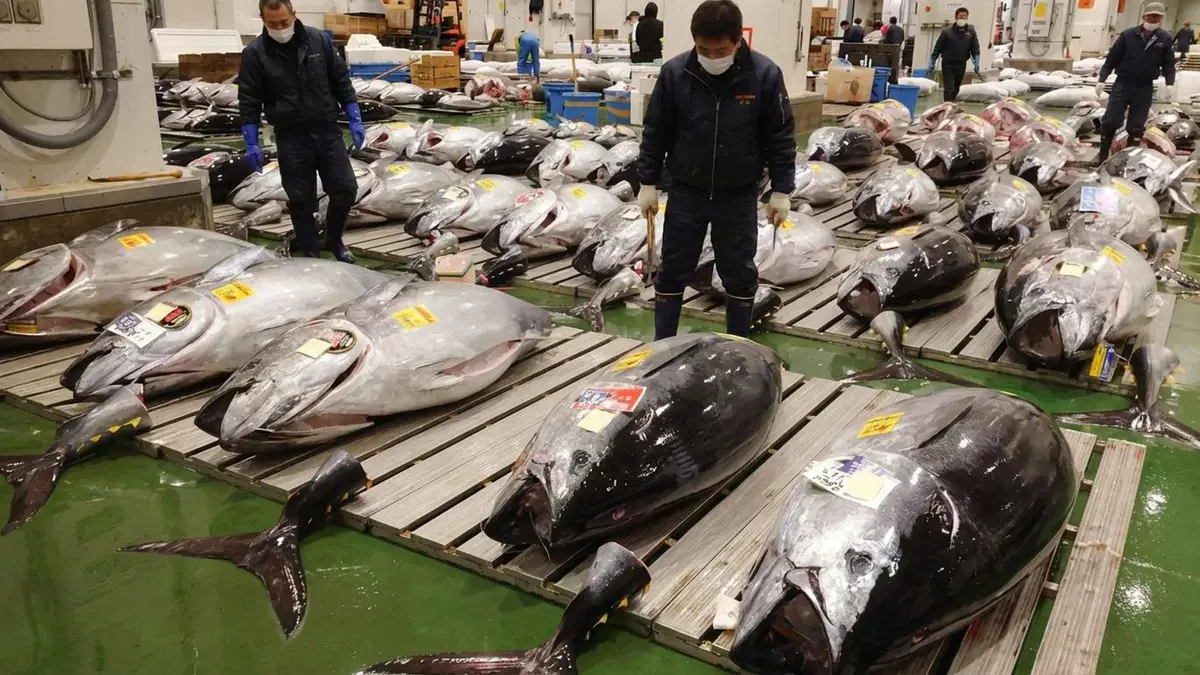 from $118.17
Tokyo: Toyosu Tuna Auction &Tsukiji Market Gourmet Adventure
A 3.5-hour early-morning tour combining the Toyosu tuna-auction viewing deck, a seafood breakfast and a stroll through Tsukiji Outer Market. Starts at 5 AM and isn't suitable for wheelchair users or guests over 70.
Check Availability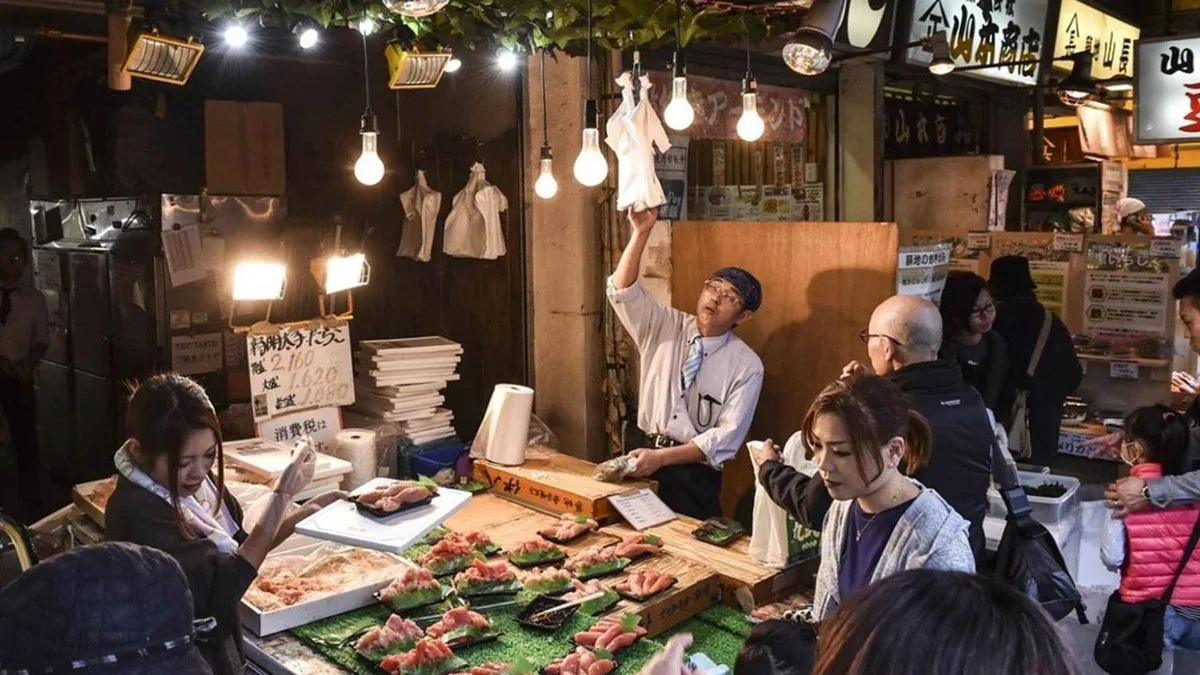 from $93.10
Tokyo: Tsukiji Fish Market Tour, TeamLab Planets & Subway
Guided morning walk through Tsukiji Outer Market, then a self-guided teamLab Planets visit, linked by an included 24-hour subway pass. Official e-tickets arrive by email; the booking voucher alone will not get you in.
Check Availability from $77.92
Tokyo: Shibuya Food Tour (13 dishes and 3 Eateries)
A three-hour small-group walk through Shibuya's Dogenzaka and Center Gai, stopping at three eateries for around 13 local dishes and two drinks, plus a photo stop at Shibuya Crossing.
Check AvailabilityPrices, ratings and details are the platform's own, checked in Q3 2026; dollar figures are the listed prices — the platform bills in your account's currency.
What Stayed, What Left, And Why The Difference Matters
The single most common trip-planning mistake in this district is booking a morning here to see something that is no longer here.
Tsukiji was two things stacked on one site. The inner market was the Tokyo Metropolitan Central Wholesale Market: the auction floors, the licensed intermediate wholesalers, the turret trucks, the frozen tuna laid out in rows under bare bulbs. Around it, on the streets to the north and east, grew a second market of retailers, knife shops, dried-goods merchants, tamagoyaki grills and small restaurants that fed and supplied the trade.
When the wholesale operation moved across the bay, the first market went with it. The second one did not move at all. That second market, the outer market, is what you visit today.
The distinction is not academic. The auction, the licensed buyers, the 05:00 spectacle and the enormous refrigerated halls are all at the new site, which keeps its own hours and its own closed days and is covered on the Toyosu page. What remains in Tsukiji is a dense grid of narrow lanes with roughly 460 businesses in it, which the operator states on its own visitor pages: fresh fish, tuna specialists, shellfish, dried bonito, seaweed and tea, pickles, tsukudani, kitchenware, Japanese tableware, knives, and eateries running from six-seat sushi counters to sashimi rice bowls and standing tempura.
So is it a tourist trap now
It is a fair question and it is the one the search results argue about, so here is the honest reading. The outer market has always been a retail street: it sold to restaurants, to caterers and to local households long before it sold to visitors, and its own literature describes wholesale shops that began retailing smaller portions so that a family, or a passer-by, could buy an egg roll one bite at a time. What has changed is the ratio.
Streets nearest the stations now carry more prepared food for immediate eating and fewer sacks of dried mushrooms than they did. Go two lanes in, towards the knife and tableware shops and the dried-goods merchants, and the trade side is still there, still doing business with people in white coats.
The useful test is what you want from the morning. If you want to watch a wholesale market work, this is the wrong address and Toyosu is the right one. If you want to eat six or seven small things standing up, buy a knife that will outlive you, and see a food street that is still supplying professionals at 07:00, this is exactly the place, and it is free.
Tsukiji In Seven Dates
Each of these is argued somewhere else on the page. The list is here so the ground reads in order rather than in themes.
-
1657
The Great Fire of Meireki
Edo burns, and the shogunate decides to fill in the coastal margin of the bay. The reclaimed ground is named Tsuki-ji, literally constructed land, which is where the district's name comes from and why the whole area is flat and low.
-
After the reclamation
Shrines and samurai housing
The new land is quiet: temples, shrines and residences for samurai families rather than trade. Namiyoke Inari Jinja, the shrine that still sits at the market's eastern edge, dates from this settlement and is dedicated to warding off disaster and riding out the waves.
-
The twentieth century
The wholesale market arrives
The Tokyo Metropolitan Central Wholesale Market operates on the Tsukiji site, and the surrounding streets fill with the retailers, tool shops and eateries that serve it. The two markets, inner and outer, grow into each other.
-
Through the post-war decades
The outer market becomes a supply street in its own right
Shops that began as wholesalers start retailing high-end goods in family-sized portions, which is how a professional supply street becomes somewhere a visitor can buy a single piece of tamagoyaki. The market's own welcome text describes exactly this shift.
-
The relocation
The wholesale trade leaves for Toyosu
The auctions, the licensed intermediate wholesalers and the inner market buildings go across the bay to Koto-ku. The outer market stays where it is, on its own streets, under its own shopkeepers' association.
-
Since the move
Tsukiji Uogashi opens as the fresh-produce anchor
A building of seafood and seasonal vegetable and fruit sellers, listed by the market as one of its three visitor anchors alongside the information centre and the shrine, keeps the fresh trade physically present in the outer market.
-
1 November 2026
Japan's tax-free system changes shape
The National Tax Agency moves tax-free shopping to a refund method: you pay the tax at the till, have the goods confirmed by customs on departure, and the shop refunds you afterwards. It matters here because the market signposts a tax-refund and delivery service for exactly the knives and dried goods people carry home.
Reclamation, shrine and market-shift dates as told in the history and welcome sections of the market's own site, tsukiji.or.jp, read in Q3 2026. The tax-free reform is from the National Tax Agency's own published outline of the 2026 change.
Hours And Closed Days: The Calendar The Shops Actually Follow
This is the part every other page on the subject gets vague about, so here is the precise position, including what nobody publishes.
There is no market-wide opening time. The Tsukiji Outer Market is a shopping street of independent businesses, not a venue with a door, and the operator does not publish a single set of hours because it cannot: each shop opens and shuts when its owner decides. What the operator does publish is a calendar, and a footnote under it that is more useful than the calendar itself.
The calendar shown on the market's own site is the Tokyo Metropolitan Central Wholesale Market's closure calendar, and the footnote says, in plain terms, that some outer-market shops are closed on those days too and that business days for any particular shop must be confirmed with the shop directly.
That is the honest answer to the opening-hours question, and it is why the practical advice on this page is built around a pattern rather than a timetable. Read the calendar for your own dates before you fix the morning. Here is what it showed when we read it, and what the two facilities the market itself runs are open for.
| What | Weekdays and Saturday | Sundays, holidays and closure days | Notes |
|---|---|---|---|
| Plat Tsukiji information centre | 08:00 to 14:00 | 10:00 to 14:00 | English-speaking staff, maps, transport help, stroller storage at 500 yen a stroller |
| Public lounge | 06:00 to 16:00 | 07:00 to 16:00 | The place to sit down; opens two hours before the information centre |
| Individual shops | Not centrally published | Many closed | The operator states these vary by shop and must be checked with the shop |
| Buyer priority window | Until 09:00 | Until 09:00 | A house rule, not a closure: you may be there, you are asked to keep out of the way |
| The barbecue site | Thursday, Friday and Saturday | Not stated | Listed as a market attraction on its own visitor pages |
How many days a month is it actually shut
More than people expect. The wholesale calendar for the month we read closed the market on ten separate days: every Sunday, four Wednesdays, and two consecutive national holidays that fell on a Monday and a Tuesday. One Wednesday in the same month was marked as a special trading day rather than a closure, which is exactly why the pattern is not a rule you can memorise.
Sunday and Wednesday are the days to be suspicious of; the calendar is the only thing that settles it.
The best hour, and why it is not the earliest
Guidebooks push a dawn arrival, which is a hangover from the auction days. It does not fit this market. Before 09:00 you are in the buyers' window, when the market politely asks you to stay out of the way of people working; the fried-food and tasting counters that visitors come for are not all up and running yet; and the information centre is not open until 08:00.
Arrive between 09:00 and 09:30 and you get full shutters, no wholesale traffic to dodge, and about three hours before the street begins winding down. Leave it until 13:00 and you will be walking past closed shutters wondering where the market went.
How Much Time To Give The Tsukiji Outer Market
The market publishes no suggested visit length, so the three routings below are ours, timed on the walking distances rather than guessed.
The whole market is roughly a 300-metre grid, which means the time you spend is decided entirely by how many queues you join, not by how far you walk. Three honest shapes for the morning:
| Routing | Door to door | What you get | What you skip |
|---|---|---|---|
| The quick pass | 45 to 60 minutes | One walk down the main lane, two or three things eaten standing at the counters that sell them, the shrine at the end | The knife and tableware shops, the dried-goods lanes, any queue longer than ten people |
| The proper morning | 2 to 2.5 hours | The full grid including the back lanes, Tsukiji Uogashi for fresh produce, a sit-down bowl, and time to actually buy something and have it wrapped | Nothing much, other than a second breakfast |
| With a guide | 2 to 3 hours | A two-hour guided walk at $12.99, or the three-hour food walk at $97.40 with five tastings ordered for you | The trial and error of working out which counter is worth the queue |
If you are pairing this with the auction across the bay, the shape changes completely: the combined auction and market morning at $118.17 starts before dawn at Toyosu and brings you back here for breakfast, which is a five-hour commitment before most people have had coffee. The alternative is to keep them on separate days, which the three-day itinerary does.
The Eating Rule, And The Seven Others The Market Publishes
The market has written its house rules down, in English, under the heading Eight tips on manners. They are short, specific and worth reading before you arrive, because two of them will surprise you.
The one that catches visitors out is the eating rule. Street food here is not walk-and-eat food. The market's published request is that you eat inside the eatery or in front of the shop you bought from, and it gives the reason: wandering while eating blocks a narrow lane that other people are working in.
Every counter that sells a skewer or a rolled omelette has a strip of pavement in front of it for exactly this, and standing there for ninety seconds with your food is the normal, expected behaviour. Walking down the lane with a scallop shell in each hand is not.
The other seven, condensed from the market's own English text:
- Buyers come first until 09:00. If you see someone moving through the shops buying, get out of their way. This is a working supply street, not a food court.
- Leave the luggage behind. Large bags obstruct the lanes; use a coin locker. Strollers can be left at the Plat Tsukiji information centre for 500 yen each.
- Move in small numbers. The lanes are narrow and the shops are small; the market explicitly asks groups not to travel as a block, and asks you to hold a child's hand.
- Ask before you photograph a shop. Some shops post a no-photography notice; the rest expect you to ask the person behind the counter first.
- Do not touch the food. Prodding a fish lowers what it can be sold for. If you need to check something, ask.
- Do not haggle. Selected goods are sold at wholesale prices and bargaining is not a custom here. The price is the price.
- Smoke only in the designated areas. No smoking while walking, no cigarette ends on the ground.
If you are the one guiding
The market has a separate note for anyone bringing a group, and it is unusually direct: do not run a tour inside a shop without asking, do not block a shop front, and understand that free samples are put out for people who are considering a purchase rather than as a buffet. It asks first-time guides to talk to the information centre before they start. The paid walks on this page work with that; a self-organised group of twelve moving as one block is the thing the rule exists to stop.
Cash, Cards And The Tax-Free Question
Tokyo is far more card-friendly than its reputation, but a 300-metre street of family businesses is where the reputation is still earned.
Carry cash. Not because cards are refused everywhere here, but because the acceptance is shop by shop and there is no way to know from the pavement which six-seat counter takes a card and which has never installed a terminal. A market of independent businesses does not publish a payment policy, and neither the operator nor any of its English pages states one, so the safe assumption is that the smallest and best counters are cash.
Two or three ten-thousand-yen notes broken into smaller ones will cover a morning of eating and a knife.
If you need cash on the spot, Seven Bank's ATMs are the standard answer for a foreign card in Japan: they take Visa, Plus, American Express, Discover, JCB, Diners Club and China UnionPay, run in twelve languages, and cap a single withdrawal at 100,000 yen, or 30,000 yen if your card is being read from the magnetic stripe. They will also offer to convert the amount into your home currency at their rate, which is a worse deal than letting your own bank do it. The Tokyo costs page has the wider money picture.
Eat in or take away, and why the receipt differs
Japan's consumption tax is 10% as standard, but food and non-alcoholic drinks bought to take away are charged at the reduced 8% rate, and dining out is specifically excluded from that reduction. In a market where the same grill sells you the same skewer to eat standing outside or to sit down with, that difference shows up on the till. It is not a discount to chase, but it explains why two people can pay different amounts for the same item, and it is published by the National Tax Agency rather than being market folklore.
Tax-free shopping, and the change coming
The market signposts a tax-refund and delivery service, which is aimed squarely at the knives, tableware and dried goods that people want shipped rather than carried. The rule that matters: the minimum tax-free purchase is 5,000 yen excluding tax, and from 1 November 2026 the whole system changes shape. Instead of the tax being lifted at the till on your passport, you pay it, get customs confirmation on departure within ninety days of buying, and the shop refunds you afterwards.
The old distinction between general goods and consumables disappears, along with the 500,000 yen ceiling on consumables and the sealed-packaging requirement.
This Market Or The One Across The Bay
Two sites, two completely different mornings, and one decision that is easier than the internet makes it look.
The comparison below is built from what each operator publishes about itself: hours and the buyer-priority rule from the market's own English pages here, and general visitor hours, closed days and auction-viewing arrangements from the Tokyo Metropolitan Government's own listing for the wholesale site. The dates and slot numbers there belong to that page and are argued in full on the Toyosu guide.
| These streets | The wholesale site across the bay | |
|---|---|---|
| What it is | About 460 retail shops, stalls and small restaurants on public streets | The working wholesale market, viewed from corridors and galleries |
| Start time that works | 09:00 to 09:30 | 05:00, for a tuna auction that runs roughly 05:45 to 06:25 |
| Cost | Free, no ticket | Free to enter; the close-up viewing deck is limited to about 120 places a day by advance application |
| Closed | Sundays, most Wednesdays, holidays, on the wholesale calendar | Wednesdays, Sundays, national holidays and irregular market days |
| Why you would go | To eat, to shop, to be on a food street | To watch the trade itself, once, very early |
Our reading: they are not substitutes and they are not a pair you have to choose between. If you have one morning, come here, because it is the one that gives you something to eat and something to buy. If the auction is the reason you flew, treat it as a separate pre-dawn expedition and add these lanes for breakfast afterwards, which is precisely what the combined morning does.
Five Things Most Visitors Do Not Know About The Tsukiji Outer Market
Each of these comes off an official page rather than a listicle, and the source is printed in brackets so you can check it yourself.
- There is a free public lounge, and it opens at 06:00, two hours before the information centre and earlier than most shops. On Sundays, holidays and closure days it opens at 07:00 and runs to 16:00 either way. It is the answer to arriving too early with nowhere to sit (market operator's own facility hours, tsukiji.or.jp).
- The information centre will hold a stroller for you, at 500 yen a stroller. The same rule asks you to put wheeled luggage in a coin locker rather than drag it through the lanes (market's published manners, tsukiji.or.jp/english/guide/).
- The market's suggested plan starts at the information desk at 09:00, then the shrine at 09:15, then shopping at 09:30. That is the operator's own recommended route, not a blogger's, and it is a good argument against the dawn arrival everyone else recommends (market's visitor pages, tsukiji.or.jp).
- There is a barbecue site, and it runs Thursday, Friday and Saturday. It appears on the market's own list of things to do here alongside the shrine and the fresh-produce building, and almost never in English coverage (market's visitor pages, tsukiji.or.jp).
- Free samples are not a tasting menu. The market states in writing that samples are put out on the assumption that the customer is considering buying, and it says so in the section addressed to tour guides, which tells you how often the assumption is tested (market's guidance for guides, tsukiji.or.jp/english/guide/).
In The Lanes: What To Do, And What Not To
Every line here is a decision argued above, compressed into the form you can act on that morning.
Do
- Check the wholesale closure calendar for your own date before you plan the morning around this street
- Arrive between 09:00 and 09:30, after the buyers' window and before the shutters start coming down
- Eat standing in front of the shop you bought from, which is what the strip of pavement there is for
- Carry cash, and break a 10,000 yen note before you reach the six-seat counters
- Walk two lanes off the main run to the knife, tableware and dried-goods shops, which is where the trade still is
- Ask before photographing a shop, and read the notice if there is one
Don't
- Don't come for the tuna auction: it is at Toyosu, across the bay, at 05:00
- Don't plan a Sunday or a Wednesday without checking, and don't assume a national holiday is a trading day
- Don't walk and eat, and don't drift into the lane with food in both hands
- Don't bring the suitcase; put it in a coin locker and leave the stroller at the information centre
- Don't haggle, and don't touch the fish to see how firm it is
- Don't arrive at 13:30 expecting a market: by then it is a street with some shutters up
Getting There, And Which Exit To Use
Four stations put you within three minutes of the lanes, and the market publishes the walking times itself.
The market's own access page lists four ways in, and the distances are genuinely short: Tsukijishijo station on the Toei Oedo line is a one-minute walk, Tsukiji station on the Tokyo Metro Hibiya line is a one-minute walk, and Higashi-ginza station is three minutes away on either the Toei Asakusa line or the Hibiya line. Coming from the Ginza end on foot is pleasant and takes about ten minutes down Harumi-dori.
| Station | Line | Walk | Use it if |
|---|---|---|---|
| Tsukiji | Tokyo Metro Hibiya | 1 minute | You are coming from Ginza, Roppongi, Ueno or Akihabara |
| Tsukijishijo | Toei Oedo | 1 minute | You are coming from Shinjuku or Roppongi on the Oedo loop |
| Higashi-ginza | Toei Asakusa / Hibiya | 3 minutes | You are coming from Asakusa, or heading on to a matinee at the Kabukiza Theatre afterwards |
| On foot from Ginza | None | About 10 minutes | You have shopped in Ginza first and want to arrive along Harumi-dori |
Whichever station you use, the first thing worth finding is the Plat Tsukiji information centre. It hands out the market's own map and a walking map of the surrounding district, the staff speak English, and they will tell you which shops are trading that day, which is the one piece of information no website can give you in advance. If the language runs out, they carry a translation device.
Getting to the area from the airports is covered on the Haneda and Narita pages, and the pass arithmetic that makes these four stations cheap is on getting around Tokyo.
Tsukiji Outer Market map: the stations, the centre and what is next door
The four station entrances the market lists, its own information centre, and the three places within a ten-minute walk. The market pin sits on the Tsukiji district coordinate rather than a street address, because the operator publishes no single address for itself.
Station walking times as published by the market on its own access page, read in Q3 2026. The market coordinate is the Tsukiji district point recorded on Wikidata, used because no single address is published for the market itself.
Where to go when the shutters come down
The market thins out from about midday, which lands you in Chuo-ku at lunchtime with the afternoon free. Walk minutes are our estimates from the mapped distances.
Kabukiza Theatre
The matinee starts at 11:00 and single-act tickets are sold for one act at a time, which fits a morning that ended early. The Kabukiza page explains how the fourth-level queue works and what the caption device costs.
6 min walkGinza
Straight up Harumi-dori into the department stores, and into their basement food halls, which are the other half of Tokyo's food story. Ginza also closes its main avenue to traffic on weekend afternoons.
10 min walkToyosu Market
The wholesale operation that used to be here, now on the far side of the bay with its own opening hours and its own closed days. The Toyosu page has the auction-viewing rules and why it needs a 05:00 alarm.
About 20 minutes by trainTsukiji Outer Market questions
What are the Tsukiji opening hours?
There is no single opening time, and the operator does not publish one, because every shop sets its own. The two facilities the market runs itself are fixed: the Plat Tsukiji information centre opens 08:00 to 14:00 on weekdays and Saturdays and 10:00 to 14:00 on Sundays, holidays and market closure days, and the public lounge runs 06:00 to 16:00, or 07:00 to 16:00 on those same days. In practice the shops are at full strength from about 09:00 and thinning by 13:00, which is why the hours section recommends arriving at 09:00 to 09:30.
Is the Tsukiji Outer Market worth going to?
Yes, if you want to eat and shop on a working food street, and no if you have come to watch a wholesale market run. It is free, it takes 45 minutes at a minimum and about two hours properly, and roughly 460 businesses trade there, from six-seat sushi counters to knife makers. If what you actually pictured was the auction, that is at Toyosu and needs a 05:00 start. The $12.99 guided walk is the cheapest way to be told what you are looking at.
Is the Tsukiji market open on Sundays and Wednesdays?
Often not. The market shows the Tokyo Metropolitan Central Wholesale Market's closure calendar on its own site, and adds that some outer-market shops close on those days as well, with each shop's own days to be confirmed with the shop. On the month we read, ten days were closed: every Sunday, four Wednesdays and two consecutive national holidays. One Wednesday that month was a special trading day instead. Check the calendar against your own dates rather than trusting a rule of thumb.
Can you eat while walking around Tsukiji?
No, and this is the market's own published request rather than an unwritten custom. You are asked to eat inside the eatery or in front of the shop that sold it to you, because the lanes are narrow and people are working in them. The strip of pavement outside each counter is there for this. The same set of rules asks you not to touch the food, not to haggle, to leave large bags in a coin locker, and to ask a shopkeeper before photographing their stall.
What time should you arrive at Tsukiji, and is dawn better?
Between 09:00 and 09:30, and no. The dawn advice is left over from when the auction was on this site. The market gives professional buyers priority until 09:00, the information centre does not open until 08:00, and not every counter is running before then. Arrive at 09:00 and the market's own suggested route has you at the information desk, at Namiyoke Inari Shrine by 09:15 and shopping by 09:30, with three good hours ahead of you.
Do you need cash at the Tsukiji Outer Market?
Bring it. Payment acceptance is decided shop by shop across hundreds of independent businesses and nobody publishes which take cards, so cash is the assumption that never fails. Seven Bank ATMs take foreign cards, run in twelve languages and allow up to 100,000 yen in one withdrawal, or 30,000 yen from a magnetic stripe. Decline their offer to convert to your own currency. The broader money picture is on what Tokyo costs.
How long should you spend at the Tsukiji Outer Market?
The market states no suggested length. Our routing: 45 to 60 minutes for one pass down the main lane with two or three things eaten standing, two to two and a half hours to do the back lanes, buy something and sit down for a bowl, and two to three hours if you take a guided walk or the food walk with five tastings. The grid is only about 300 metres end to end, so the time goes on queues, not on distance.
Where This Market Fits In A Tokyo Day
It is a morning, it is free, and it pairs with a specific afternoon rather than with anything at all.
Treat it as the first thing you do, not the last. A morning that starts here at 09:00 has you fed, finished and standing in Chuo-ku by 11:30 with the whole day in front of you, and it costs nothing. The natural continuations are all within walking distance: the Kabukiza Theatre six minutes away, where a single act is sold on its own and the matinee begins at 11:00; Ginza ten minutes up Harumi-dori for the department-store basements; or the water, since the river boats leave from this side of the city.
What it does not pair with is another eating stop. Six small things at the counters here is a meal, and pencilling in lunch afterwards is the most common way to waste an afternoon. If you want the eating to be the day rather than the morning, the where to eat in Tokyo page sets out the ladder from a standing counter to a booked kaiseki seat, and the Shibuya food walk is the evening version of what you did here at breakfast.
And if you are building the whole trip rather than one morning, the three-day itinerary places this market on the morning it works best.
The Market On Film: Lanes, Counters And What People Actually Order
Three walk-throughs shot in the lanes. Watch any one of them and the layout, the queue lengths and the standing-and-eating convention stop being abstract.
Tsukiji Fish Market New & Hidden Gems Japanese Street Food
A slow walk through the lanes counter by counter, which is the clearest look at how the standing-and-eating convention works in practice.
Video: Paolo fromTOKYOJAPANESE FOOD TOUR! Eating at TSUKIJI MARKET in Tokyo, Japan
One morning eaten end to end, useful for seeing portion sizes and how far a handful of small purchases actually goes.
Video: CupofTJTSUKIJI Outer Market, TOKYO: Worth It or a Tourist Trap? My HONEST Review
The tourist-trap question taken seriously on camera, which is the argument this page's opening section makes in writing.
Video: Greta's TravelsVideos load from YouTube only when you press play.
Reviewed Q3 2026 (July–September 2026); next review Q4 2026. Prices, hours and terms are set by the venue or operator and confirmed at checkout.
We may earn a commission if you book through one of our links, at no extra cost to you. Full affiliate disclosure