 Visit Tokyo Guide
Shinjuku, Tokyo
Shinjuku, Tokyo's western hub, has a free observation deck open until 22:00, a national garden at $3.24 (¥500) and the busiest railway station on earth, which moves an average of 2.7 million passengers a day by the Guinness World Records figure from its 2022 measurement, roughly four times the count at Paris Gare du Nord. That number is why the district reads as overwhelming, and why the obstacle here is almost always the station rather than the streets around it. It is one of seven districts compared on this Tokyo guide. Everything above ground is arranged around it: the free observation decks and the office towers on the west side, the national garden to the south east, the department stores at the east exit, and behind them the neon blocks of Kabukicho with Golden Gai and Omoide Yokocho on either flank. This page sorts out which exit you actually want, what each part of the district is for, what the drinking alleys charge and how they charge it, and where the money traps genuinely are. Yen figures are the operators' and the garden's own, read in Q3 2026; dollars are converted at ¥1,000 = $6.48.
Quick answer Which exit, what it costs, and the order to walk it in
Leave Shinjuku Station by the West Exit for the towers and the free view, by the East Exit for the shops and the nightlife, and by the New South Exit for the bus terminal. The district costs nothing to walk: the only standing admission charge in it is $3.24 (¥500) for the national garden, and the twin observation decks on the metropolitan government building are free and need no booking.
Key takeaways
- The free observation decks close on different days from each other, the south deck on the first and third Tuesday of the month and the north deck on the second and fourth Monday, so one of the two is almost always open. Which one, and the exit that reaches them, is in the west side section.
- The garden closes on Mondays and shuts as early as 16:00 in winter, which catches out people who plan it as an evening stop. The three seasonal timetables are in the sights table and on the Shinjuku Gyoen page.
- Nobody publishes a Golden Gai cover charge, because there is no single one: each bar posts its own on the door and some charge nothing at all. What to read before you push a curtain aside is in the Golden Gai section.
- If the alleys look impenetrable, a 90-minute evening walk of the backstreets at $22.21 gets you inside them with someone who orders, and a longer four-stop food walk turns the same lanes into dinner.
The Fixed Points In Shinjuku, With Hours And Closed Days
The four things in the district that have published hours rather than shop hours, taken from the garden's own site at fng.or.jp and from the Tokyo Metropolitan Government's tourism pages, all read in Q3 2026. Everything else in Shinjuku is a shop, a bar or a street, and keeps its own time.
| Place | Hours | Adult price | Closed | Nearest exit |
|---|---|---|---|---|
| Shinjuku Gyoen National Garden | 09:00 to 16:00 from 1 October to 14 March; to 17:30 from 15 March to 10 June and 1 August to 30 September; to 18:30 from 11 June to 31 July | $3.24 (¥500); $1.62 (¥250) for students and over-65s; free for junior high and under | Mondays, or the next weekday when Monday is a national holiday; 29 December to 3 January | Shinjuku-gyoenmae, Marunouchi Line |
| Metropolitan building, south deck | 09:30 to 22:00, last entry 21:30 | Free | First and third Tuesday of each month, plus building inspections and the New Year holiday | Tochomae, Toei Oedo Line, Exit A4 |
| Metropolitan building, north deck | 09:30 to 17:30, last entry 17:00 | Free | Second and fourth Monday of each month, on the same conditions | Tochomae, Toei Oedo Line, Exit A4 |
| Hanazono Shrine | Grounds open; the shrine publishes no visitor timetable | Free | Not stated | Shinjuku-sanchome, Exit E2 |
| Omoide Yokocho and Golden Gai | Bar and stall hours, set individually; the lanes fill from about 18:00 | Free to walk; each bar sets its own charge | Many Golden Gai bars close on Sundays | West Exit for Omoide Yokocho, East Exit for Golden Gai |
Two of these five publish nothing at all, and that is the honest answer rather than a gap: Hanazono Shrine keeps no visitor timetable and the alleys are private businesses with no association tariff. Garden hours and closures come from the National Gardens Association page at fng.or.jp; the deck hours and their split closure days from the city's own tourism pages at gotokyo.org.
Two Guided Ways Into The Backstreets
Both of these walk the same lanes this page describes, and both exist because the barrier in Shinjuku is social rather than physical: the alleys are open to anyone, but the doors are small and the menus are often only in Japanese. Prices are the platform listings in US dollars as they stood in Q3 2026, and each card opens the operator's own page with the live calendar.
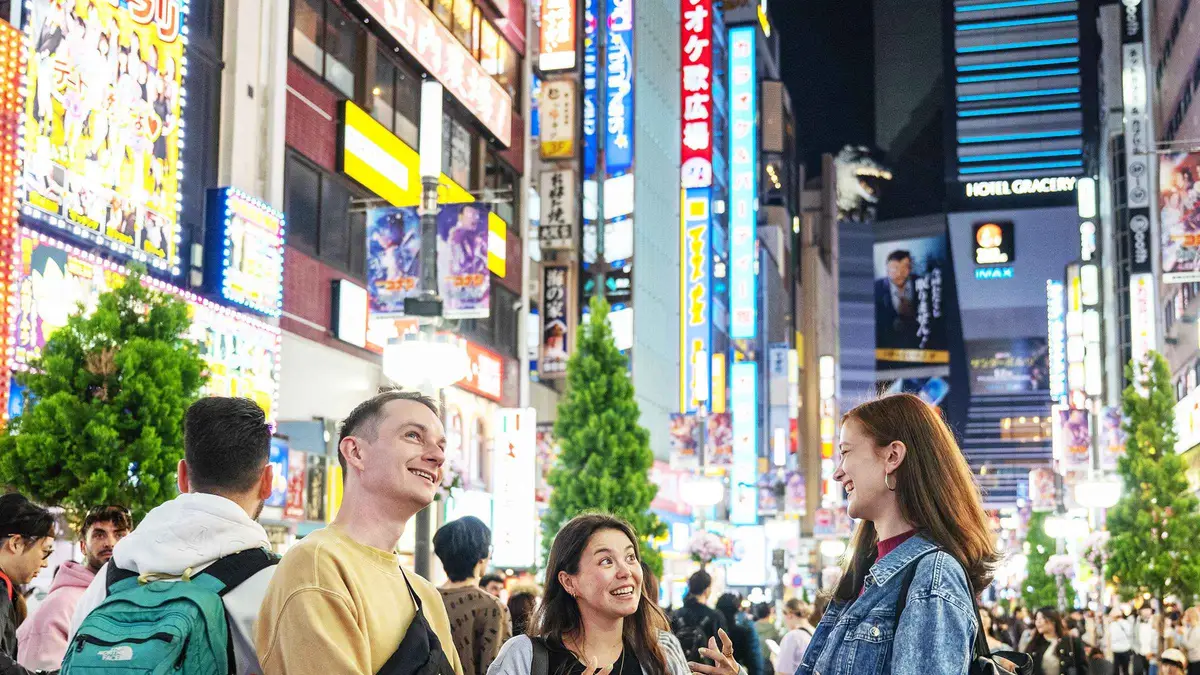 from $22.21
Tokyo: Shinjuku Nightlife & Secret Backstreets Walking Tour
A 90-minute evening walk through Shinjuku's Kabukicho, Golden Gai and Omoide Yokocho with a local guide, covering the district's red-light-district history and a stop at Hanazono Shrine.
Check Availability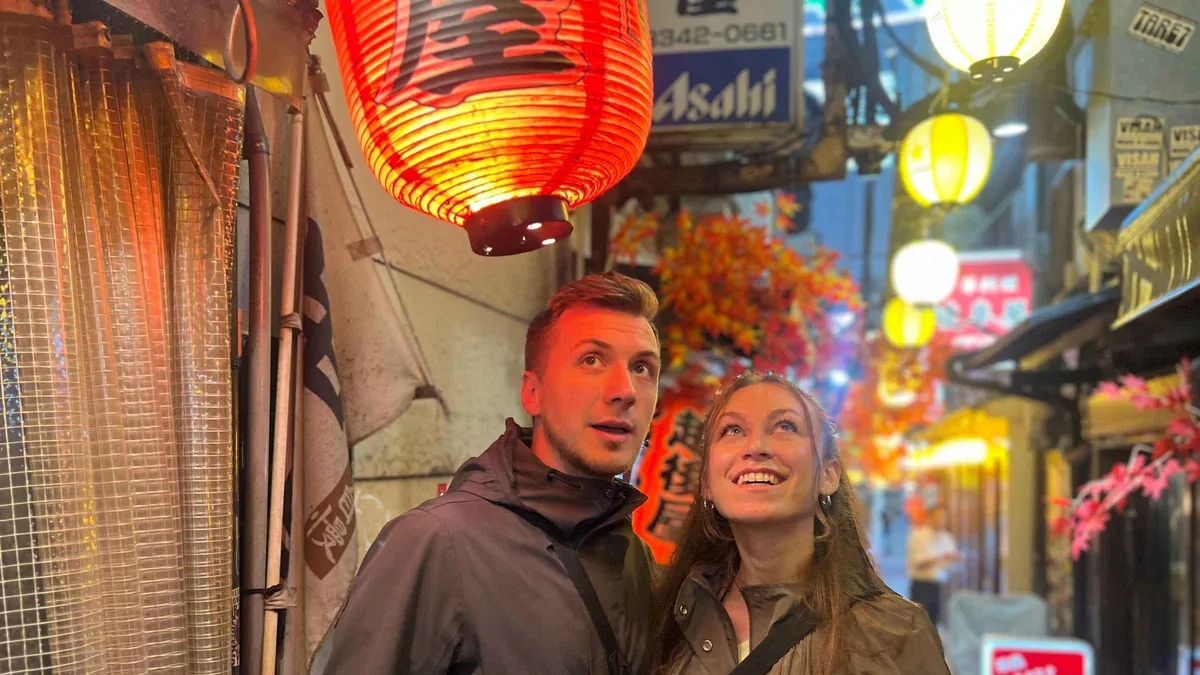 from $85.71
Tokyo: Shinjuku Food Tour (15 Dishes and 4 Eateries)
A three-hour small-group walk through Shinjuku's Omoide Yokocho and Kabukicho backstreets, stopping at four eateries for around 13 Japanese dishes and two drinks with an English-speaking local guide.
Check AvailabilityPrices, ratings and details are the platform's own, checked in Q3 2026; dollar figures are the listed prices — the platform bills in your account's currency.
The Station That Defeats People, And How To Leave It
Shinjuku Station is not one station. It is a JR complex with five private and municipal railways plugged into it at different levels, and the exits belong to different companies. This is why the usual advice, follow the signs, fails: the signs are correct and there are simply too many of them.
The first thing to understand is that the station has no single concourse. JR East sits in the middle, Keio and Odakyu run their own terminals to the west and south west, the Marunouchi Line comes in under the east side, and the Toei Oedo and Toei Shinjuku lines run beneath everything on their own alignments. Each of those has its own ticket gates, and once you are through a gate you are in that company's passage network, not a shared one.
The practical consequence is that the exit you want is chosen before you tap out, not after.
The second thing is that the underground passages continue for several hundred metres past the gates in every direction, and the surface entrances they lead to have names of their own. Shinjuku Nishi-guchi, Shinjuku-sanchome, Seibu-Shinjuku and Tochomae are separate stations with separate fares, all within walking distance of the JR gates and all connected underground. This is a genuine advantage once you know it: in bad weather you can cross most of the district without going outside.
| Exit | What it puts you in front of | Use it for |
|---|---|---|
| East Exit | The department-store frontages and the entrance to the Kabukicho blocks | Shopping, the food halls, Kabukicho, Golden Gai, Hanazono Shrine |
| West Exit | The bus circle, the electronics stores and the start of the skyscraper district | Omoide Yokocho, the office towers, the walk to the free observation decks |
| South Exit and New South Exit | The elevated crossing over the tracks, and the expressway bus terminal | Long-distance buses, the newer shopping complexes, the walk south towards the garden |
| Shinjuku-gyoenmae, Marunouchi Line | A quiet street two minutes from the garden's Shinjuku Gate | Going straight to Shinjuku Gyoen without crossing the station at all |
| Tochomae, Toei Oedo Line, Exit A4 | The base of the twin-towered metropolitan government building | The free observation decks, about a minute on foot |
The one rule that removes most of the difficulty
If you are arriving in Shinjuku for a specific thing, do not get off at Shinjuku. Take the Marunouchi Line to Shinjuku-gyoenmae for the garden and the Toei Oedo Line to Tochomae for the towers, and you step out of a small station straight onto the street you wanted. Both are a single stop from the main station and both are covered by the same 24-hour subway ticket at $6.48 (¥1,000) that you were probably going to buy anyway.
The main station is worth entering only when you are actually changing trains or heading for the shops attached to it.
One more practical point about leaving. The bus terminal above the New South Exit is where the overnight coaches to Kyoto, Osaka and the mountains leave from, and it is a fifteen-minute walk from the East Exit with luggage. If you are catching one, allow for that walk rather than for the map distance.
Coin lockers across the whole complex fill by mid-morning on weekends, and the reliable overflow is the paid luggage rooms in the basements of the department stores rather than more lockers.
The West Side: Towers, And The View Nobody Charges For
West of the tracks the district changes completely. Nishi-Shinjuku is a planned quarter of office towers built on the site of a filled reservoir, and it is quiet at street level in a way the east side never is. It also holds the best free thing in central Tokyo.
The Tokyo Metropolitan Government Building has two observation decks, one in each of its towers, and neither charges anything. The south deck is open from 09:30 to 22:00 with last entry at 21:30, which makes it the only high viewpoint in the city that is free after dark. The north deck runs 09:30 to 17:30 with last entry at 17:00.
The closure days are deliberately staggered, the south closing on the first and third Tuesday of each month and the north on the second and fourth Monday, so on any given day one of them is normally working. Full detail, including how the queue behaves, is on the observation deck page.
The comparison worth making is with the paid decks elsewhere in the city. A ticket for Shibuya Sky or the Skytree buys height, a designed experience and a timed slot that guarantees you get in. The free decks here buy a good west-facing panorama with Mount Fuji visible on clear winter afternoons, and cost nothing but the walk from Tochomae Exit A4.
If your trip has one high view in it, the paid ones are better. If it has three, this should be one of them.
What else is on this side
Omoide Yokocho, described below, is on this side of the tracks despite feeling like it belongs with the nightlife. So does the large electronics retail cluster around the West Exit, which is the same trade Akihabara is known for and often cheaper for cameras. After dark the building facade of the metropolitan government building carries a projection-mapping show, run by the city and free to watch from the plaza.
Beyond that, Nishi-Shinjuku is offices: pleasant to walk, with almost nothing open on a Sunday.
Kabukicho: What Is Actually There, And What To Refuse
Kabukicho is the block north east of the station, and it has a reputation that is half earned. It is Tokyo's largest entertainment district, it is genuinely safe to walk, and it contains a small number of businesses that exist to overcharge foreign visitors. Both halves of that are true at once, and the difference between them is entirely about how you got through the door.
What is straightforwardly there: cinemas, a bowling alley, several hundred restaurants, karaoke chains, arcades, capsule hotels, a large modern tower with a hotel and entertainment floors on the western edge, and the Godzilla head that looks over the street from a hotel terrace. Hanazono Shrine sits on the eastern side, about ten minutes from the station, and is a working Shinto shrine with a flea market on some Sundays. None of that requires any special care.
Families walk through it, the main streets are lit and busy until the small hours, and violent crime against visitors is not the risk.
The risk is a specific and well-documented one: bars that quote no prices, reached by following someone who approached you in the street. The pattern is consistent enough to state as a rule rather than a warning. If a person on the pavement offers to take you to a bar, a club or a show, the answer is no, every time, without exception and without needing a reason.
Anywhere worth going to in Shinjuku is found by walking in off the street yourself, and every honest bar in the district either posts its charges at the door or tells you when you sit down. This is the single most useful sentence on this page and it costs nothing to follow.
The tourist-trap question, answered plainly
Kabukicho as a place is not a tourist trap. It is a real entertainment district that Tokyo residents use, and the crowds in it are overwhelmingly local. What is a trap is a small number of venues inside it that price by the customer rather than by a menu.
Robot-restaurant-style theatre shows, hostess and host bars, and anything advertised by a tout belong in that category by default. The ordinary izakaya, ramen counters, karaoke chains and cinemas do not. Walking the district costs nothing and is worth an hour on any evening; entering a venue you did not choose yourself is where the money goes.
One practical note on hours. Kabukicho has a curfew culture rather than a legal closing time: the last trains leave the station between about midnight and 00:30, and the district's own rhythm changes sharply after that, becoming louder, drunker and more male. If you are not staying nearby, plan the evening around the last train rather than around when you feel like leaving. Getting around Tokyo sets out how the last-train problem works across the network, and taxis from here at 01:00 are expensive and slow.
Golden Gai: The Cover Charge, And Why No Number Is Published
Golden Gai is six narrow lanes on the eastern edge of Kabukicho, packed with something over two hundred bars, most of them seating fewer than a dozen people. It is the most photographed drinking quarter in Tokyo and the one visitors most often walk through without entering, because nothing about it explains itself from outside.
Start with the fact that decides the evening: there is no Golden Gai cover charge. There is no association tariff, no published rate and no authority that sets one. Each bar is an independent business, most of them tiny and family-run, and each decides for itself whether to add a seating charge on top of the drinks.
Some charge nothing. Some post a figure on a sign by the door, in Japanese and often in English too. Some apply it only to first-time customers.
Anyone quoting you a single figure for Golden Gai is generalising from the two bars they went into.
What that means in practice is simple. Read the door before you open it. A bar that wants your custom will have written its charge, its opening hours and often the words welcome or English menu on a board outside.
A bar with nothing written and a closed curtain is not hostile, it is a regulars' bar, and walking past it is the correct response rather than a missed opportunity. Walking all six lanes takes about ten minutes and gives you a dozen candidates with legible signs, which is a far better method than picking the first door you reach.
How the lanes actually work
The bars are themed to a degree that surprises people: film bars, punk bars, jazz bars, horror bars, bars devoted to a single author. Capacity is the constraint, not price, and a bar with six seats and five regulars in it will genuinely be full. Most open around 20:00 and run late; a significant number close on Sundays.
Cash is still the norm in the smallest places. If you want to look at the lanes rather than drink in them, go at about 17:00, when the lanterns are lit and the alleys are empty, and photograph them then.
If the idea of choosing blind is the obstacle, that is exactly what the evening backstreets walk is for at $22.21: ninety minutes with a local guide through Kabukicho, these lanes and Hanazono Shrine, which at minimum leaves you able to come back on your own the next night. The longer food walk does the same job through four eateries and about thirteen dishes, and is a dinner rather than an orientation.
Omoide Yokocho: The Other Alley, And Why It Is Different
Omoide Yokocho runs along the railway embankment on the west side of the station, two minutes from the West Exit. It gets confused with Golden Gai constantly and works nothing like it.
The difference is that Omoide Yokocho is about food. It is a strip of roughly sixty tiny counter restaurants, most of them grilling yakitori and kushiyaki over charcoal, with a handful of ramen and soba counters. You eat there; you drink alongside the food.
Golden Gai is the reverse. That also means the seating charge question mostly disappears here: you order dishes and drinks off a menu, and the bill is the sum of them. Cash is preferred at many of the stalls and some do not take cards at all.
The lane opens for dinner rather than for lunch, and the grills are properly going by 17:30. Seats are the scarce resource: each counter has six to ten of them, and from about 18:30 on a Friday or Saturday you queue or you walk on. Two people can usually be seated somewhere within ten minutes; a group of five cannot, and should not try.
The alley is roofed, narrow and thick with charcoal smoke, which is part of the point and also a reason to leave a good coat at the hotel.
The name, and what it tells you
The lane grew out of a postwar black market beside the tracks and kept the improvised layout, which is why the buildings are one room deep and the upper floors are reached by ladder-steep stairs. Its old nickname refers, unflatteringly, to the era's lack of plumbing; the modern alley has none of that problem, but the name survives in guidebooks and confuses people about the state of the place. It is clean, it is legal, and it is one of the few surviving pieces of that Tokyo anywhere near the centre.
Department Stores, And The Food Halls In Their Basements
The east exit of the station opens onto a row of department-store frontages, and the interesting floor in each of them is the one below ground. Japanese department stores put their food halls in the basement, and the Shinjuku ones are among the largest in the country.
What is down there is not a supermarket. It is a hall of individual counters, each run by a separate confectioner, butcher, pickle-maker, tea merchant or bakery, most of them long-established businesses with a single specialism. Bento boxes are assembled and sold whole; seasonal sweets change with the month; the wrapping is done at the counter and takes as long as the transaction.
Prices run from a few hundred yen for a single pastry to figures a visitor would not believe for a boxed melon.
For a traveller the halls do two useful things. They solve dinner on a night when you do not want to queue anywhere, because everything in them is sold to take away and most stores discount prepared food in the last hour before closing. And they solve gifts, since almost everything is already packaged for giving.
The department stores themselves publish their opening hours store by store rather than as a district timetable, so check the specific shop's own site for the day you are going; most run to around 20:00 with the basement closing last.
Where else the money goes here
Shinjuku is a shopping district before it is a nightlife one, and the mix is unusually wide: the department stores at the east exit, large electronics chains at the west exit, discount stores open around the clock in Kabukicho, and Korean groceries and cosmetics a couple of stops north at Shin-Okubo. If you are pricing a trip rather than shopping on it, what Tokyo costs has the daily figures, and tax-free purchasing rules are worth reading before you spend, since they apply per store and per day.
The Garden Next Door, And What It Is For
A ten-minute walk south east of the station, the noise stops. Shinjuku Gyoen is a former imperial garden of 58 hectares, and it is the reason a day in this district does not have to be relentless.
Admission is $3.24 (¥500) for an adult, $1.62 (¥250) for students and visitors over 65, and free for children of junior-high age and under. There is no reservation, no timed slot and no queue worth the name outside cherry-blossom season. The closing hour moves three times a year, at 16:00 from 1 October to 14 March, 17:30 through spring and late summer, and 18:30 from 11 June to 31 July.
The garden closes on Mondays, and on the following weekday when a Monday is a national holiday, plus the New Year period from 29 December to 3 January.
Two things to know before you go in. Alcohol is not permitted inside, which makes it a different proposition from a Tokyo park; nor are sports equipment and musical instruments. And the Monday closure is the single most common wasted walk in this district, because it coincides with the day much of the rest of the city closes too, which is set out in full on what is open on Monday.
The garden's own page, its seasonal detail and the three separate entrance gates are covered on the Shinjuku Gyoen guide.
How Long Shinjuku Takes, And When To Come
The honest answer is that Shinjuku is an evening district with a garden attached, and the two halves do not want to be done in the same three hours.
A short version is two hours: out of the West Exit, up to the free deck for the panorama, back down through the tower district, and into Omoide Yokocho when the grills start. That gets you the geography, the view and dinner, and it can be dropped into a day that started somewhere else entirely.
| How much time | What you do | What it skips | What it costs |
|---|---|---|---|
| Two hours, late afternoon | Free observation deck, walk east through the towers, dinner in Omoide Yokocho | The garden, Kabukicho, Golden Gai | Dinner only, plus one subway fare |
| Half a day, from about 14:00 | Garden first, then the deck at dusk, then the alleys after dark | The department stores and the shopping | $3.24 (¥500) plus food and drink |
| A full day | Garden in the morning, food hall lunch, shops, deck at sunset, Golden Gai after 20:00 | Nothing in the district | $3.24 (¥500) plus what you eat, drink and buy |
| An evening only | East Exit, a walk through Kabukicho, then one bar in Golden Gai | Everything on the west side | Whatever the bar posts on its door |
On timing across the week: Monday removes the garden, Sunday thins out Golden Gai, and the last trains between about midnight and 00:30 set the real end of the evening. Rain barely matters here, since the underground passages, the station complex, the department stores and the arcades connect for most of the distance. The one weather-dependent thing is the deck view, which is worth checking against a clear day if Mount Fuji is what you came up for.
Where Shinjuku fits in a trip
Most first-time itineraries put Shinjuku in the evening and something else in the daytime, which is right. It sits on the western side of the Yamanote loop, four minutes from Harajuku and seven from Shibuya, so the three of them make an obvious west-side day that ends here after dark. Pairing it with Asakusa or Odaiba on the same day means crossing the city twice and is the mistake the neighbourhoods hub exists to prevent.
Where the district sits against the rest of the city is set out on the Tokyo city guide homepage.
Shinjuku On The Map: Exits, Alleys And The Garden
The station and the six places this page sends you to, with the two small stations that reach the garden and the towers directly. Pin positions are taken from the venues' own published coordinates on the OpenStreetMap base layer; distances between them are ten to fifteen minutes on foot at most.
The two stations marked in blue are one stop from the main complex and each opens onto its target street directly, which is the fastest way to reach the garden or the towers without crossing Shinjuku Station at all.
Where To Go Next From Shinjuku
The three pages that carry on from this one, in the order a trip usually needs them.
Shinjuku Gyoen
The garden in full: the three gardens inside it, the seasonal closing hours, the cherry and chrysanthemum calendars, and which of the three gates to use. Read the Shinjuku Gyoen guide.
10 minutes on footThe free observation decks
How the two decks differ, what the queue does at sunset, when Mount Fuji is actually visible, and how the free view compares with the paid ones. Read the observation deck guide.
1 minute from Tochomae Exit A4Tokyo neighbourhoods
Which district suits which traveller and which evening, how many of them fit in a day, and the Yamanote-line model that makes the city legible. See all seven districts compared.
The routing pageStaying In Shinjuku, And What The Trade-Off Is
Shinjuku is the most common first-trip base in Tokyo, for one reason: almost every line in the city passes through it, and both airports run direct services here. What you pay for that is noise and a long walk from the platform to the street. The three sub-areas below behave very differently from one another.
West Shinjuku, the tower district
- Walk to Shinjuku Station
- 5 to 12 minutes from the West Exit
- Suits
- Quiet nights, high floors, business-grade hotels, an easy walk to the free decks
The calmest part of the district after dark and the least interesting at ground level, since it is an office quarter with little open on a Sunday. The walk from the JR gates is longer than the map suggests because you cross the whole station complex.
See stays in West Shinjuku, the tower districtEast Shinjuku and Shinjuku-sanchome
- Walk to Shinjuku Station
- 2 to 8 minutes from the East Exit
- Suits
- Being in the middle of the shops, the food halls and the evening, with three subway lines at Shinjuku-sanchome
Loud until late, and the closer to Kabukicho the louder. A room facing an interior courtyard matters more here than the hotel's star rating.
See stays in East Shinjuku and Shinjuku-sanchomeSouth Shinjuku, towards the garden
- Walk to Shinjuku Station
- 6 to 15 minutes from the New South Exit
- Suits
- Travellers who want the connections without the neon, and anyone using the expressway bus terminal
Residential within two streets, and the quietest of the three at night. The trade-off is that you are ten minutes from everything the district is famous for rather than in it.
See stays in South Shinjuku, towards the gardenWe do not publish nightly rates for Tokyo areas, because they move by season and by event more than any figure would survive; the links above open a live search for the dates you enter. The wider comparison of Tokyo bases, including the areas that are cheaper than this one, is on where to stay in Tokyo. We take a commission if you book through these links, at no extra cost to you.
Shinjuku Questions
Which exit of Shinjuku Station should I use?
East for the department stores, Kabukicho and Golden Gai; West for Omoide Yokocho and the tower district; New South for the expressway bus terminal. If your destination is the national garden or the free observation decks, do not use Shinjuku Station at all: take the Marunouchi Line one stop to Shinjuku-gyoenmae or the Toei Oedo Line one stop to Tochomae. The full breakdown is in the station section.
Is Kabukicho safe to walk at night?
Yes, as a place. The main streets are busy and lit until the small hours and violent crime against visitors is rare. The real risk is commercial rather than physical: a small number of venues price by the customer, and they are reached by following someone who approached you in the street. Refusing every street approach removes almost all of it. The Kabukicho section sets out what is genuinely there, and safety and scams in Tokyo covers the city-wide picture.
How much is the cover charge in Golden Gai?
There is no single figure, because there is no association tariff and no authority that sets one. Each of the two hundred-odd bars decides for itself, some charge nothing, and the ones that do charge post it on a board by the door. Read the door before you open it, and treat any bar with no written information as a regulars' bar rather than a bargain. The Golden Gai section explains how to walk the six lanes first.
What is the difference between Golden Gai and Omoide Yokocho?
Golden Gai is for drinking, Omoide Yokocho is for eating. Golden Gai has around two hundred tiny themed bars on the east side of the station and opens properly after 20:00; Omoide Yokocho is roughly sixty charcoal-grill counters along the tracks on the west side, with the grills going from about 17:30. If you want dinner, go west; if you want a bar, go east. Both are covered above, and an evening guided walk at $22.21 takes in the pair of them.
Is Shinjuku worth visiting during the day?
For two things, yes. The national garden at $3.24 (¥500) is one of the best hours in central Tokyo and closes on Mondays, and the department-store food halls are a genuine sight rather than a shop. The rest of the district is an office quarter and a shopping street until the light goes. If you have one visit in you, make it late afternoon into evening, which the timing table sets out hour by hour.
How many hours does Shinjuku need?
Two hours covers the free deck and dinner in the alleys. Half a day, starting at about 14:00, adds the garden and gets you into the bars afterwards. A full day is only worth it if you are shopping, since the district's sights are few and its interest is atmospheric. The four routings are compared in how long Shinjuku takes, and the neighbourhoods hub shows what else fits in the same day.
Is it better to stay in Shinjuku or somewhere else in Tokyo?
Shinjuku is the strongest base for connections in the city, with almost every line and both airport services running through it, which is why so many first trips start here. The costs are noise, a long walk from platform to street, and prices that reflect the demand. The three sub-areas behave differently, as the staying section explains, and the alternatives are compared on where to stay in Tokyo.
Shinjuku On Film: The Station, The Towers And The Alleys
Three walk-throughs that show what this page describes at street level, which is the fastest way to understand a district whose whole character is atmosphere rather than sights.
Tokyo Evening Walk in Shinjuku - 4K HDR 60fps Spatial Audio
An unedited evening walk that covers the East Exit, Kabukicho and the alleys at the hour this page recommends.
Video: Prowalk ToursTOP 20 Things to Do in Shinjuku, Tokyo
A run through the district's fixed points, useful for seeing how far apart the west and east sides really are.
Video: Tokyo CheapoShinjuku Tokyo Japan Nightlife - Kabukicho Walking Tour
Kabukicho after dark at walking pace, including the streets where the touting described above happens.
Video: MyJourneySoloVideos load from YouTube only when you press play.
Reviewed Q3 2026 (July–September 2026); next review Q4 2026. Prices, hours and terms are set by the venue or operator and confirmed at checkout.
We may earn a commission if you book through one of our links, at no extra cost to you. Full affiliate disclosure